Showing posts with label Bourbon. Show all posts

Tuesday, 17 January 2012

Pre-Whisky Fest Fun: Day 4

Whisky Cocktails.  I could not think of two words that would make most whisky "aficionados" (AKA: Snobs) cringe more.  Even adding a cube of ice to a nice whisky is enough to raise the blood pressure of said "aficionados".  So it would come as no surprise if this following blog post gave a few people heart attacks, because this blog post is all about whisky cocktails!

Now before I begin, I do have one rules when making a cocktail with any spirit, not just whisky.  I'll never mix a spirit that I have to pay more than $80 dollars for.  To give you a good example of the ridiculous taxation on alcohol here in British Columbia, here are some very common bottles (750ml) and their prices:


  • Ballantine's Finest - $25.99
  • Glenfiddich 12 Year Old - $48.99
  • Highland Park 12 Year Old - $66.95
  • Laphroaig 10 Year Old - $84.99
  • Lagavulin 16 Year Old - $124.99
  • Macallan 18 - $249.99

Flower of Scotland
- 1 oz Glenfiddich 12 Year Old
- 1 oz Giffard's Ginger of the Indies
- 1 oz Noilly Prat Dry Vermouth
- 2 Dashes of Angostrua Bitters

- Add all ingredients to mixing glass
- Add ice and stir
- Strain into chilled cocktail glass
- Garnish with a flamed lemon zest


The idea behind this cocktail was to deconstruct the flavours present in Glenfiddich 12 year old (ginger, christmas spices, citrus), and highlight those particular flavours.

Blood and Sand
- 1 oz Blened Scotch
- 0.75 oz Cherry Herring
- 0.75 oz Sweet Vermouth
- 1 oz Orange Juice

- Add all ingredients to cocktail shaker
- Add ice and shake
- Double Strain into chilled cocktail glass
- Garnish with flamed orange zest

Blood and Sand
A favorite cocktail of mine, the Blood and Sand is a classic cocktail named after the equally classic 1922 movie of the same name.  

For this particular cocktail I like to use a blend with a pronounced smokiness, like Black Grouse.  I find that lightly smoky blends tend to get lost amounts all the other ingredients. 

One note about cherry herring, if you're like me and live in B.C. you probably know we can't get cherry herring here.  The best alternative is the cherry liqueur from Okanagan Spirits.

1806 Whisky & Cola
- 2 oz Bourbon
- 0.33 oz Kola Tonic
- 2 Dashes Chocolate Bitters
- 2 Dashes Fernet Branca

- At the bottom of a mixing glass muddle one large orange zest
- Add all remaining ingredients to mixing glass
- Add ice and stir
- Strain into chilled rocks glass with one large ice cube
- Garnish with flamed orange zest

1806 Whisky & Cola
An obvious twist on the Old-Fashioned, the 1806 Whisky & Cola is named after the year in which the word "Cocktail" was first defined in print.  If you are wondering what the hell kola tonic is, it is basically concerted cola syrup.  A quick google search of "Cola Syrup" will reveal various sites that carry the product.  If you are a B.C. resident, I suggest outofafricatrading.com. They are B.C. based so your product will arrive in no time. 

The Scofflaw
- 1.5 oz Rye Whisky
- 1 oz Dry Vermouth
- 0.75 oz Lemon Juice
- 0.75 oz Real Pomegranate Grenadine

- Add all ingredient to cocktail shaker
- Add ice and Shake
- Double Strain into chilled cocktail glass
- Garnish with a long thin lemon twist


Another classic prohibition era cocktail from Harry's New York Bar in Paris, The Scofflaw is a reference to the 20s term of the same name.  A "Scofflaw" was a term coined by the media to describe someone who enjoyed visiting his/her local speak-easy.

Saturday, 7 January 2012

Classic Cocktail of The Month: Boulevardier

If you were to go into any reputable cocktail lounge, no problems would occur if you were to order a Negroni.  Every bartender knows how to make one -or at least should know- and most bartenders would even recite to you the story of the origin of the Negroni.  So the story goes in short, in 1919, Count Camilo Luigi Manfredo Maria Negroni travels to Italy where he demands the bartender of Cafe Casoni, Fosco Scarselli, to prepare his Americano with gin in lieu of club soda: thus the Negroni is born.  A close relative of the Negroni, the Boulevardier, sees only a fraction of the limelight in comparison to the Negroni.  While a recipe of the Negroni does not see print until more then a decade after its inception, the Boulevardier appears in the 1927 Barflies and Cocktails, by Harry McElhone.

Now, if you were to order a Boulevardier in most bars, chances are you would only get a confused look in exchange.  The Boulevardier is a cocktail that has only recently seen a revival.  Once again, due to Ted "Dr. Cocktail" Haigh's Vintage Spirits and Forgotten Cocktails, another prohibition cocktail now lives again.

Boulevardier
- 1.5 oz Bourbon
- 1 oz Campari
- 1 oz Sweet Vermouth


- Add all ingredients to mixing glass
- Add ice and stir
- Strain into chilled cocktail glass
- Garnish with a orange zest


Unfortunately, due to BC liquor laws, cocktails must not exceed 3 ounces of liquor (regardless of the ABV),  So we have to opt for the equal parts approach; a great cocktail non the less.


Sticking to the DNA of the Boulevardier (whisk(e)y, bitter aperitif, and fortified wine), I've utilized an Islay Single Malt, Tawny Port, and every bartender's favorite, Fernet Branca in this month's variation.   Just a warning anyone who is wanting to try this drink, this is one of those drinks that you really have to like Fernet Branca to enjoy.


Gaelic Medicine
- 1 oz Laphroaig Quarter Cask
- 1 oz Fernet Branca
- 1 oz Late Bottled Vintage Port

- Add all ingredients to mixing glass
- Add ice and stir
- Strain into chilled cocktail glass
- Garnish with a orange zest


Thursday, 3 November 2011

Classic Cocktail of The Month: The Lion's Tail

One of the biggest challenges with recreating old cocktail recipes is tracking down hard to find -and some times extinct- cocktail ingredients.  It was not until recently that mixologists couldn't even create an Aviation, due to the absence of creme de violette.  Most of the classic tiki drinks call for things such as falnerum, pimento dram (or more commonly referred to as "allspice dram") and many other ingredients that have become misplaced in time.  Thanks to the work of outstanding companies like Bitter Truth, we are finally seeing a resurrection of these once deceased ingredients.  Much credit must also be given to Ted "Dr. Cocktail" Haigh, author of Vintage Spirits and Forgotten Cocktails.  Without the publication of Mr. Haigh's book,  there would be nearly no demand for such obscure ingredients such as pimento dram.

With the winter months fast approaching, the mojitos and margaritas are slowly exiting center stage.  In their place, egg nog and hot toddys begin to fill the glasses of winter imbibers.  When we think winter drinks, we think of those typical holiday flavors, nutmeg, cinnamon, allspice, often dusted over the top of an egg nog or brandy alexander.  Nearly all of these winter drinks follow one of two paths, either hot or creamy; there seems to be no middle ground for those not whiling to fully except the cold reality of winter.

Taking a page from Ted Haigh's Vintage Spirits and Forgotten Cocktails, I present, The Lions Tail.  The first publication of The Lion's Tail comes from CafĂ© Royal Cocktail book in 1937.

The Lion's Tail
- 2 oz Bourbon
- 0.75 oz Pimento Dram (Or less, to taste)
- 0.5 oz Lime Juice
- 1/2 Tablespoon Simple Syrup
- 2 Dashes Angostura Bitters

- Add all ingredients to cocktail shaker
- Add ice and shake
- Double strain into chilled cocktail glass
- No garnish necessary


As you can see on a side note beside pimento dram, it mentions adding less, and I highly recommend doing so.  The pimento dram can easily over power this drink.  Trying using 1/2 ounce to begin with and adding from there.  It is also a personal preference of mine to increase the amount of lime juice to 3/4 ounce.

Even with these forgotten liqueurs finally coming back on the shelves, their distribution is fairly limited.  In BC we are still without a commercial allspice dram.  So what do you do?  Make your own of course!

The recipe is very simple, the hardest part is being patient.

Home Made Pimento Dram
Makes 1.5 L of liqueur

- 2 1/4 Cups 151 Proof Rum
- 1/2 Cup Dried Allspice Berries
- 3 Cups Water
- 3 Cups Brown Sugar

- Crush allspice berries to allow for maximum surface area
- Place allspice berries and rum in a sealed mason jar for a minimum of 10 days
- Strain rum, first through a fine mesh strainer, then through a coffee fitler
- Make 1:1 simple syrup with water and brown sugar
- Mix allspice infused rum and simple syrup together
- Bottle and allow to aged for a minimum of 1 month in bottle

Now get to it!  Make that pimento dram so it will be ready in time for the holidays.  And once finished, try out this month's variation on The Lion's Tail.

The Dragon's Den
- 2 oz Blended Scotch
- 0.5 oz Pimento Dram
- 0.75 oz Lemon Juice
- 1/2 Tablespoon Honey Syrup (1:1 Honey to Water)
- 2 Dashes Highland Bitters *


- Add all ingredients to cocktail shaker
- Add ice and shake
- Double strain into chilled cocktail glass
- No garnish necessary


I don't like to brag, but I find The Dragon's tail to be a great improvement on The Lion's Tail.  The lemon plays very well with the scotch, more so then bourbon and lime.  Also, the bourbon in the Lion's Tail does struggle to keep its head above water, while the scotch cuts through and plays well with the other ingredients.  The Dragon's Tail may just be is an obvious Scottish twist on a classic, but it is one of the better original libations I have concocted.  If you don't want to spend the time making highland bitters, just use angostura, the subtle changes will be negligible.

Highland Bitters *
- 25 Grams Gentian Root
- 14 Grams Coriander Seed
- 7 Grams Orange Peel
- 7 Grams Clove
- 3.5 Grams Camomile Flower
- 3.5 Grams Cinnamon Bark
- 375ml Highland Cask Strength Single Malt

- Add ingredients to sealed mason
- Allow to infuse for one month
- Strain bitters: first through a fine mesh strainer, then through a coffee filter
- Bottle into bitters bottle


If you took the time to make The Dragon's Den -and enjoyed it- be sure to return for future blog posts during November.  I'll be doing several posts revolving around scotch, as it is getting to that time of the year in which we need a real winter warmer.

Monday, 24 October 2011

Mixology Monday: Morning Drinks

We all know the saying, "breakfast is the most important meal of the day," and I'm not going to argue.  I love breakfast.  I could eat a heaping plat of french toast, bacon, eggs and harsh browns for the every meal of the day for the rest of my life.  The only problem with this -setting health problems aside- is the time consuming preparation.  There has to be a more simple way to create an equally tasty meal with out all the work.
This month's Mixology Monday hosted by Kevin at Cocktail Enthusiast has done exactly that, liquid breakfast.  The idea of breakfast cocktails is really nothing new.  Considering that cocktails were once meant to be consumed in the morning, we are simply bringing the morning tipple to the 21st century with some modern techniques.  I've attempted to utilize all my favorite breakfast dishes that were mentioned about, that is, without going as far as making a potato liqueur...gross.


6:00 AM Sour
- 2 oz Bacon Washed Bourbon *
- 1 oz Orange Juice
- 0.5 oz AAA Maple Syrup
- 2 Dashes Acid Phosphate
- 1 Dash Angostura Bitters
- 1 Egg White
- Black Pepper Garnish

- Add egg white to mixing tin
- Add remaining ingredients to mixing glass
- Dry shake
- Add ice and shake
- Double strain into chilled rocks glass
- Garnish with fresh ground black pepper


Bacon Washed Bourbon *
- Cook 8 bacon strips in oven in a glass pan until bacon is extra crispy
- Eat bacon.
- Pour liquid bacon fat into a mason jar (make sure fat is cool but still liquid)
- Pour 500 ml of Bourbon into mason jar
- Give mason jar a good shake and place jar in freezer
- Remove mason jar from freezer after 4 hours
- With a spoon, break the solidified layer of fat that has formed at the top
- Strain bourbon through a cheese cloth (or coffee filter will do)
- Bottle bourbon and enjoy bacony goodness


If only it was socially expectable to start every morning with a breakfast like this.  Thanks to Kevin at Cocktail Enthusiast for hosting this month's MxMo.  Remember, help spread the word of MxMo via any outlet possible.  Facebook, twitter, carrier pigeon, just try to get as many people involved as we can!  Follow me on twitter at @Spirit_Imbibing

Thursday, 4 August 2011

Classic Cocktail of The Month: Twelve Mile Limit

Prohibition was both detrimental and beneficial to the cocktail culture.  Bartenders across the USA left for Europe, Canada and Cuba.  The majority of those who remained went to work in soda fountains.  Few foolishly worked illegally in speak-easys serving liquor so foul you wouldn't be cruel enough to serve it to your in-laws.  It was however the cause of many memorable cocktails, the Bee's Knees, Southside, Colony Cocktail etc. All of which share a simple formula. spirit, sugar and citrus. Due to the quality of much of the alcohol being produced at the time, this equation of imbibing was formulated to mask the terrible quality of the hooch.  But, those wishing to sip on a spiritous cocktail didn't have to travel far or risk blindness from bathtub gin.  Once 12 mines off the shore of the United States the Volstead act was void.  To toast this legal loop hole two cocktails may be found published in print.  In the 1930's Savoy Cocktail book by Harry Craddock is the "Twelve Miles Out".  A simple mixture of equal parts White Rum, Swedish Punch and Calvados.  Secondly you may find a recipe by the name of "Twelve Mile Limit" in a publication of a 1934 newspaper article.  In said article Tommy Millard is credited with creating the Twelve Mile Limit.  While extraordinarily similar in name, the cocktails share only one ingredient and are otherwise completely different tipples.  Whether Mr. Millard was aware of the previous publication of the Twelve Miles Out is unaware.  But It would not seem unlikely that more then one human being celebrated the act of legal libations during prohibition by creating a cocktail.

Twelve Mile Limit
- 1 oz White Rum
- 0.5 oz Rye Whisky (Preferably use a spicy American Rye Like Rittenhouse or Sazerac)
- 0.5 oz Cognac
- 0.5 oz Grenadine
- 0.5 oz Lemon Juice

- Add all ingredients to cocktail shaker
- Add ice and shake
- Double strain into chilled cocktail glass
- Optional garnishes include a lemon twist, lemon wheel or brandied cherry


Essentially the Twelve Mile Limit is a sour, Spirit(s), citrus and sugar.  For my variation on this cocktail I didn't dive off into the deep end with an obscure variation.  I stuck fairly close to shore while still straying far enough away from the Original Cocktail to have a personality all of it's own.

Shore Line
- 0.75 oz White Rum
- 0.75 oz Calvados
- 0.5 oz Bourbon
- 0.5 oz Agave Nectar
- 0.5 oz Lime Juice

- Add all ingredients to cocktail shaker
- Add ice and shake
- Double Strain into chilled cocktail glass
- Garnish with lemon twist*

* Yes Lemon.  Garnishing a cocktail with a ingredient that is not present in the liquid is a technique know as "Flavor Tripping".  Because 70% of what you tastes is perceived by what you smell you are tricked into thinking there is lemon in this cocktail.
Shore Line
Just a reminder.  The prepose of me doing a variation on these cocktails is to demonstrate that having a deep repertoire of classics may greatly help improve your ability to create and improvise your own libations.  The Shore Line has to be one of my favorite cocktails to surface since the inception of this segment, Classic Cocktail of The Month.  If possible give both a try while the summer weather is still around.

Sunday, 10 July 2011

Mixology Monday: Beer Cocktails

It seems like I just uploaded my last MxMo post and now it's that time again.  This month's Mixology Monday post is hosted by Fred at Cocktail Virgin Sut and Fred has chosen beer cocktails as the theme.  

"Beer has played a historical role in mixed drinks for centuries.  [...] Bartenders are drawn to beer for a variety of reasons including the glorious malt and roast notes from the grain, the bitter and sometimes floral elements from the hops, the interesting sour or fruity notes from the yeast, and the crispness and bubbles from the carbonation. Beer is not just for pint glasses, so let us honor beer of all styles as a drink ingredient."


I tend to go threw phases with my mixology and right now beer cocktails is one of those current phases.  So it wouldn't due justice to just post one of my all ready concocted recipes, not at all.  I think two new cocktails will due.  But as I've mentioned before in a previous blog post, beer isn't my drink of choice.  When I do decide to drink beer it's usually for "research purposes".  But in my last few months of "research" I have found some beers that I really do adore.  They all have one thing in common, they're all abnormal in someway.  Not you're typical ale or lager.  Whether It be flavored or aged for 77 days in oak casks, I tend to like beers with some very unique characteristics.

Weizen Ungeheuer (German for "Wheat Monster")
- 2 oz Maker's Mark
- 1 oz Fresh Squeezed Orange Juice
- 0.75 oz Lapsang Souchong Syrup *
- 3 Dashes Lemon Bitters
- 1 Egg White
- Granville Island Hefeweizen

- Add egg white to shaker tin
- Add all other ingredients excluding beer to mixing glass
- Dry shake
- Add ice and shake
- Strain in to 20 oz pint glass
- Top with Hefeweizen

Blood of The Jimador
- 2 oz Reposado  Tequila
- 1 oz Fresh Squeezed Lime Juice
- 0.75 oz Ginger Syrup **
- 2 Dashes Regan's Orange Bitters
- Fruli Strawberry Beer

- Add all ingredients excluding beer to shaker
- Add ice and shake
- Double strain into chilled champagne flute
- Top with Fruli
- Garnish with a fresh strawberry


* To make Lapsang Souchong syrup brew 1 cup of lapsang souchong tea extra strong.  Add tea to a sauce pan with 1 cup of sugar.  Heat until all sugar has dissolved.  Let cool and bottle in fridge.

** To make Ginger syrup peel and puree 2 inches of ginger root. Add to 1 cup of water over medium heat in sauce pan.  Let simmer for 5 minutes and add 1 cup of sugar.  Heat until all sugar has dissolved.  Let cool and strain through fine mesh strainer.  Bottle and keep in fridge.

Another very fun MxMo this month has now pasted.  Thanks to Fred at Cocktail Virgin Slut for an awesome theme!  Loving beer cocktails right now and I look forward to next months theme.

Sunday, 1 May 2011

Classic Cocktail of The Month: Mint Julep

May's classic cocktail of the month has inspired books, poems, a film title and bartenders.  The drink it's self pre-dates cocktails as we know them and thousands of them are made every year on the first saturday in May at The Kentucky Derby in Louisville.  This month's highlighted cocktail is of course the Mint Julep.  The history of this classic is as muddy and dark as most Mint Juleps you'll receive when ordered at a majority of bars.  When searching for historical facts about this southern favorite, you find most articles will somewhere mention a concoction of water and rose petals refereed to as a "Gulab" which translates to "Rosewater" in arabic.  This medicinal blue print for today's Julep dates back centuries before bourbon and mint even first met.

It isn't until 1787 when the Julep is first documents as an alcoholic beverage by an "Anonymous Traveller" stating: "The Virginian rises in the morning, about six o'clock.  He drinks a julap, made of rum, water and sugar, but very strong."  Still no mint but as you can see we have the spirit and the sugar.  Sixteen years later a more accurate description of the Julep we imbibe on today was first defined in 1803 by John Davis in his book "Travels of Four Years and a Half in The United States of America"  The book told of "A dram of spirituous liquor that has mint steeped in it, taken by virginians of a morning."  The liquor in question would have been most likely rum and or brandy, which was at the time most popular by historical accounts.

Still, it would take nearly another fifty years for the mixture of bourbon, sugar and mint to be undeniably defined.  In 1850 Kentucky politician, Henry Clay wrote in his personal diary a detailed description of both the preparation and ingredients that would be the Mint Julep that we are familiar with today.
"The mint leaves, fresh and tender, should be pressed against a coin-silver goblet with the back of a silver spoon.  Only bruise the leaves gently and then remove them from the goblet.  Half fill with cracked ice.  Mellow bourbon, aged in oaken barrels, is poured from the jigger and allowed to slide slowly through the cracked ice.  In another receptacle, granulated sugar is slowly mixed into chilled limestone water to make a slivery mixture as smooth as some rare Egyptian oil, then poured on top of the ice.  While beads of moisture gather on the burnished exterior of the silver goblet, garnish the brim of the goblet with the choicest springs of mint."


As you can see above, Henry Clay's account of making the Mint Julep is near identical to that of the modern bartender.  The only difference being most bartenders will leave the mint in the cup with the additional ingredients.  As well, the Julep cup should be filled to the brim and above with crushed ice.


Mint Julep
- 3 oz Bourbon (I prefer Maker's Mark for my Julep)
- 0.5 - 0.75 oz Simple Syrup (to taste, it will depend on what bourbon you're using)
- 15 - 25 Mint Leaves

- Begin by placing mint in Julep cup and gently muddle
- Add simple syrup
- Add 1.5 oz bourbon
- Fill cup half full with crushed ice and churn mixer to bring some of mint leaves to the top
- Add remaining 1.5 oz of bourbon to Julep cup and repeat previous step
- Top with crushed ice, a massive mint sprig and a straw buried amongst the mint

Mint Julep

For my variation on the Mint Julep I wanted to pay tribute to another region of the world.  Like the Mint Julep embodies the south my Julep will symbolize France.

French Julep
- 1.5 oz VSOP Cognac
- 0.75 oz Fine Calvados
- 0.75 oz Grand Marnier
- 0.25 oz Rich simple Syrup (2 parts sugar to 1 part water)
- Peel of One Orange
- 6 - 8 Mint Leaves

- Begin by placing mint and orange peels in Julep cup and gently muddle
- Add simple syrup
- Add Cognac 
- Fill cup half full with crushed ice and churn mixer
- Add remaining 1.5 oz of liquor to Julep cup and repeat previous step
- Top with crushed ice, orange twist, a massive mint sprig and a straw

French Julep

And if two were not enough, here are a few of my favorite Julep variations.  One, dating back to 1839 and the other a classic here in Victoria by friend and fellow cocktail lover Shawn Soole.

Georgia Mint Julep (Circa 1839)
- 2 oz Cognac
- 1 oz Peach Brandy
- 0.25 oz Simple Syrup *
- 8 - 12 Mint leaves

- Follow same directions for Georgia Mint Julep as you would for the Mint Julep

* According to Vintage Spirits and Forgotten Cocktails By Ted Haigh the recipe calls for a teaspoon of sugar and a dash of water, so using simple syrup just takes one unnecessary step out of the equation.

Austrian Julep (Shawn Soole, Clive's Classic Lounge Circa 2010)
- 2 oz Maker's Mark Bourbon
- 0.5 oz Zirbenz Stone Pine Liqueur
- 0.33 oz Raspberry Syrup **
- 6 - 8 Mint Leaves


-Follow Same directions as all Previous Juleps
- Additionally, garnish fresh washed mint sprig with powders sugar

** 1 Cup water to 1 Cup Sugar over medium heat until all sugar has dissolved.  Let cool and add 1/2 cup of fresh raspberries.  Muddle raspberries completely then strain syrup through a fine mesh strainer.

Have a Julep you like to enjoy?  or maybe just a bourbon preference, post a comment and tell me what you'll be enjoying this coming Saturday on derby day.

Sunday, 27 March 2011

Tip of the Ice Cube

Every Bartender would agree that ice is a essential ingredient in any cold drink.  Most bartenders would also agree that size matters and can make a dramatic difference.  Small ice equals more surface area therefore more dilution and the opposite applying for larger ice.  So any time I stir up an Old Fashioned I ensure to pour it over a nice big ice ball.  There has already been so much said about ice that talking about using big, "fresh" ice free of any other freezer odorous wouldn't been anything new, but what about the practice of using ice free of any impurities?  It seems as of lately some bars have been taking on the task of making their ice as clear and the glass you're drinking from.  The process is simple enough, boil water, let cool, repeat and freeze.  But what other positives asides from presentation does this pellucid ice yield?  I took the time and double boiled some filtered water.  I froze two sets of ice cube trays, one of double boiled filtered water and one of just filtered water as well as a set of ice balls.   As you can see in the pictures below there wasn't a substantial difference between the two cubes. The filtered cube was approximately between 60-65% clear and the double boiled cube was about 75-80% clear.

I then poured 2 oz of dry vermouth in separate mixing glasses. I used dry vermouth for two reasons, one I wanted something very light so I could detect subtle flavor changes and two I don't use dry vermouth often enough so it tends to oxidize before the bottles is half empty.  Next I placed eight ice cubes of the different varieties in the separate mixing glasses and stirred both for 30 seconds.  To eliminate as many variables as possible I used separate spoons, jiggers and strainers so that everything was the same temperature and wouldn't hold on to any excess liquid and wouldn't transfer any from drink to drink.
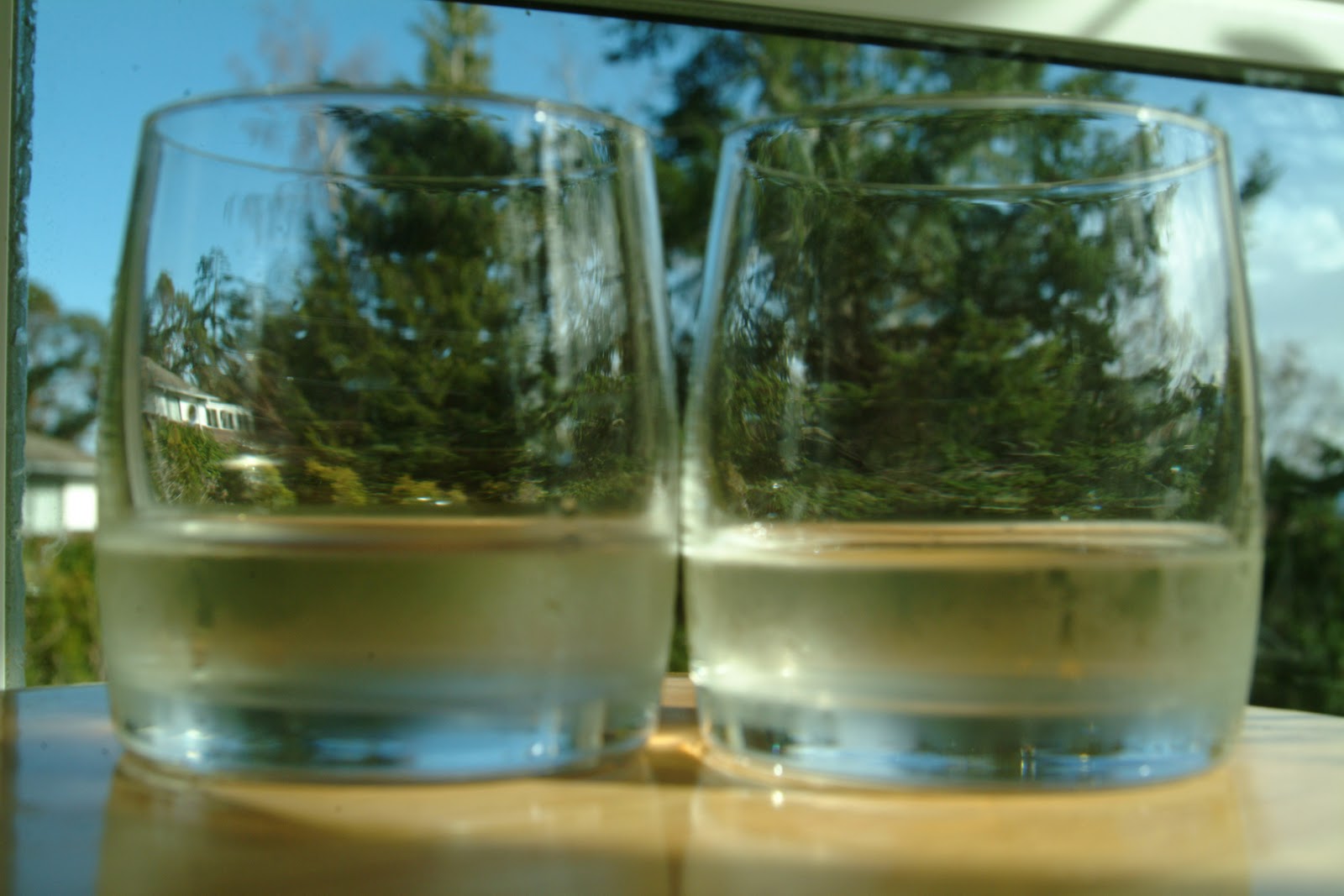
The glass on the left is vermouth stirred with the filtered ice and the glass on the right was stirred with double boiled ice.  As you can see there is a noticable difference in the volume of liquid but very negligible.  So the only thing to do now is to taste it. And was there a difference in taste?  The short answer is no, nor was there any noticeable difference in temperature.  The difference in taste was so insignificant that if you had two cocktails one after another, one being stirred with filter ice and the other with double boiled ice you would have not a clue the difference.  I then placed two ice balls in each glass and let them sit for 3 hours.  The final product of ice wasn't that different as you can see.
Filtered Ice ball left. Double Boiled Ball Right.

 There was although a drastic difference in the beginning product of the ice balls.  The double boiled ball was approximately 60-70% clear where as the filter ice was 15% at best.  So I thought, no one is going to be sipping vermouth through a straw from their undisturbed glass for 3 hours.  So for the sake of "Science" I painfully prepared two Old Fashioneds in the same fashion as the vermouth. The double boiled ball seemed to stay in one piece for the entirety of the swim, unfortunately the filtered ball didn't fare as well. Small ice chunks cracked off and eventually the entire sphere split in two and thus watering down the drink more then it's opponent.

So what's the end verdict?  In my opinion( keyword being "my", I am by no means a scientist or even a bartender) for small ice cubes, filtered water will suffice.  I do how ever think it makes a difference for big ice, whether you're freezing big blocks for cracking or just single spheres for sipping the dilution rate appears to be much slower then good ol' filtered water.  But remember this was clearly an experiment for my own pleasure and I thought it would make a good topic to blog about.  If you want to read a blog post about ice from a guy that REALLY knows what he's talking about check out Dave Arnold's (who happens to be a real scientist!) blog post on ice.