Showing posts with label Vermouth. Show all posts

Sunday, 12 February 2012

Classic Cockctail of The Month: Vancouver Cocktail

Tales of The Cocktail Vancouver has officially started, and while I maybe stuck in Victoria studying for midterms, that doesn't mean I can't enjoy a taste of Vancouver.  While many people think of the Caesar as the quintessential Canadian cocktail, there is another, lesser known, Canadian cocktail that may be a bit more akin to the style of imbibing currently overtaking the city of Vancouver.

First conceived at The Sylvia Hotel, Vancouver's first cocktail bar, in the mid 1950s, the Vancouver cocktail certainly does justice to Vancouver's cocktail scene.   A bold mixture of gin, sweet vermouth, Benedictine, and orange bitters, the Vancouver is a cocktail that receives only a fraction of attention compared to other libations named after large cities.

Vancouver 
- 1.5 oz Gin
- 0.75 oz Sweet Vermouth
- 0.25 oz Benedictine 
- 2 Dashes Orange Bitters

- Add all ingredients to mixing glass
- Add ice and stir
- Strain into chilled cocktail glass
- Garnish with an orange zest


This month's variation on the classic is a bit of a dramatic twist.  The only things left intact from the original recipe is the gin, and the proportions. 

Westshore
- 1.5 oz Gin
- 0.75 oz Late Bottled Vintage Port
- 0.25 oz Fernet Branca
- 2 Dashes Chocolate Bitters

- Add all ingredients to mixing glass
- Add ice and stir
- Strain into chilled cocktail glass
- Garnish with an orange zest


Saturday, 7 January 2012

Classic Cocktail of The Month: Boulevardier

If you were to go into any reputable cocktail lounge, no problems would occur if you were to order a Negroni.  Every bartender knows how to make one -or at least should know- and most bartenders would even recite to you the story of the origin of the Negroni.  So the story goes in short, in 1919, Count Camilo Luigi Manfredo Maria Negroni travels to Italy where he demands the bartender of Cafe Casoni, Fosco Scarselli, to prepare his Americano with gin in lieu of club soda: thus the Negroni is born.  A close relative of the Negroni, the Boulevardier, sees only a fraction of the limelight in comparison to the Negroni.  While a recipe of the Negroni does not see print until more then a decade after its inception, the Boulevardier appears in the 1927 Barflies and Cocktails, by Harry McElhone.

Now, if you were to order a Boulevardier in most bars, chances are you would only get a confused look in exchange.  The Boulevardier is a cocktail that has only recently seen a revival.  Once again, due to Ted "Dr. Cocktail" Haigh's Vintage Spirits and Forgotten Cocktails, another prohibition cocktail now lives again.

Boulevardier
- 1.5 oz Bourbon
- 1 oz Campari
- 1 oz Sweet Vermouth


- Add all ingredients to mixing glass
- Add ice and stir
- Strain into chilled cocktail glass
- Garnish with a orange zest


Unfortunately, due to BC liquor laws, cocktails must not exceed 3 ounces of liquor (regardless of the ABV),  So we have to opt for the equal parts approach; a great cocktail non the less.


Sticking to the DNA of the Boulevardier (whisk(e)y, bitter aperitif, and fortified wine), I've utilized an Islay Single Malt, Tawny Port, and every bartender's favorite, Fernet Branca in this month's variation.   Just a warning anyone who is wanting to try this drink, this is one of those drinks that you really have to like Fernet Branca to enjoy.


Gaelic Medicine
- 1 oz Laphroaig Quarter Cask
- 1 oz Fernet Branca
- 1 oz Late Bottled Vintage Port

- Add all ingredients to mixing glass
- Add ice and stir
- Strain into chilled cocktail glass
- Garnish with a orange zest


Friday, 18 November 2011

Mixology and Home Bartending for Beginners: Methods of Mixing

Well it about time that everyone who has been following this mini-series of blog posts finally learns how to actually make a drink.  So far we have covered, tools of the trade, stocking your home bar and the various non-alcoholic ingredients.  Now that you have your tools, booze, and mixes, we will learn the basic methods of mixing.

There are three basic methods to making drinks: building, stirring and shaking.

Building
Building is the most simple of techniques.  The biggest factor to consider when making a built cocktail is the type of ice you use.  The type of ice you use depends on three factors, alcoholic strength of the cocktails, level of desired dilution, and desired temperature.  With out going into the full details (which can be found in an early post here), ice with a large surface area (eg. crushed ice) will give more dilution and thus chill a drink more sufficiently.  The opposite applying for ice with a small surface area (eg. cube ice).

To make a built drink, simply add your base ingredients (spirits citric, syrups), then add your ice, top -if necessary- with addition carbonated ingredients (eg. soda, ginger beer).  Last, stir gently and garnish.  Here are two cocktails that utilize the technique of building.

Tom Collins
- 2 oz Gin
- 0.75 oz Lemon Juice
- 0.75 oz Simple Syrup
- Soda Water

- Add  Gin, lemon and simple syrup to collins glass
- Fill glass with cracked ice*
- Top with soda water
- Gently stir and garnish with a lemon zest** and straw


* Cracked ice is simply cubed ice that has been cracked into smaller pieces.  This can easily be done with your bar spoon by giving a cube of ice a swift smack.  For more on ice visit my last post for beginners, Ingredients.

** using a potato peeler, peel length wise a long strip of lemon.  Express oils over top of cocktail.  Clean up edges with a pairing knife and drop zest in glass.

Mojito
- 2 oz White Rum
- 0.75 oz Lime Juice
- 0.75 oz Simple Syrup
- 8 - 10 Mint Leaves
- Soda Water

- Add mint leaves to bottle of collins glass
- Very Gently, muddle mint to extract the oils from the leaves
- Add white rum, lime and simple syrup
- Fill glass half full with crushed ice and churn mixture
- Fill glass full with crushed ice
- Top with a splash of soda water
- Garnish with a massive sprig of mint, lime wheel and straw


The Mojito is one of the most bastardized cocktail around.  Here are some dos and don't of the Mojito.

DO: Use only fresh lime juice
DO: Use crushed ice
DO: Served this cocktail in a tall glass

DO NOT: Muddle the mint into a paste
DO NOT: Shake a Mojito.
DO NOT: Drown the cocktail with soda water

Stirring
It is a general rule that we stir drinks consisting only of clear ingredients (eg; spirits, bitters, syrups).  So your Martinis Manhattens, Sazeracs etc. are all stirred drinks.  There are several reasons as to why we stir a cocktails: presentation, texture, temperature and dilution.

It is a common saying that we eat with our eats.  That saying also applies to how we imbibe.  Take a look at the two pictures below.  To the left is a stirred Manhattan, and to the right is a Manhattan that has been shaken.  The stirred Manhattan will be perfectly clear, and the shaken Manhattan cocktail will have a slight haze.  Try this experiment at home for your self, you'll notice a major difference in look and mouth feel.

Manhattan
- 2 oz American Rye Whisky
- 1 oz Sweet Vermouth
- 2 Dashes Angostura Bitters

- Add all ingredients to mixing glass
- Add ice and stir for 30 seconds
- Strain into a chilled cocktail glass
- Garnish with an orange zest


If you were to taste the two side by side, the stirred cocktail has a silky texture, while the shaken cocktail is a bit more heavy in the mouth.  Shaking aerates the cocktail, resulting in a drastically difference mouth fell, which may be undesirable.


Pre-Prohibition Martini
- 2 oz Gin
- 1 oz Dry Vermouth 
- 1 Dash of Orange Bitters

- Add all ingredients to mixing glass
- Add ice and stir for 30 seconds
- Strain into a chilled cocktail glass
- Garnish with an lemon zest

Remember, keep your vermouth refrigerated!  If the level of the bottle reduces enough that you can transfer it into a smaller bottle, do so.  The less air in the bottle, the longer the vermouth will last.

While presentation and texture may come down to preference, dilution is the primary factor in why we stir.  Stirring is much less of a violent act than shaking, and thus dilutes the drink less.  One thing to remember is dilution = chilling.  A stirred drink will not be nearly as cold as the same drink that has been shaken.  It would take 2 minutes of stirring to achieve the level of dilution and chill that 15 seconds of shaking will achieve.

More information on the science of dilution and chilling can be found at Dave Arnold's blog Cookingissues.com

Shaking
Shaking is using for drinks containing fruit juice, cream, eggs, or any other ingredients that need to be thoroughly mixed into a drink.  You may stir drinks that contain fruit juice, (Never egg or cream!)  but the drink will not achieve the same consistency, texture and temperature that may be desired from a shaken drink.

Here are two drinks that should always be shaken:

Whisky Sour
- 2 oz Whisky (Your Preference)
- 1 oz Lemon Juice
- 0.5 oz Simple Syrup
- 1 Dash Angostura Bitters
- Egg White

- First add egg white to cocktail shaker. (In case you break the yolk or drop the shell in the shaker, you don't ruin the entire drink)
- Add all remaining ingredients to cocktail shaker
- Dry shake *
- Add cubed ice to shaker
- Shake for 15 seconds
- Double strain into chilled rocks glass **

* Dry Shake: A dry shake is a technique used for cocktails containing egg.  By adding the spring from a hawthorn strainer into the cocktail shaker (without adding ice), shake the cocktail for 10 seconds to whisk the egg white.  Then remove the spring and add ice.  Continue shaking as you would with any other cocktail.

**Double Strain: Use a tea strainer (aka, fine mesh strainer) to strain out any additional ice, bits of fruit, or any other undesirable debris.  This results in a drink with a smoother texture.  99% of all drinks I shake are double strained.  An sufficient alternative to double straining is pressing the gate of the hawthorn strainer closer to the edge of the shaker tin.  I use this technique for straining a Ramos Gin Fizz, which is the one shaken cocktail I do not double strain.


Brandy Alexander
- 1.5 oz Cognac
- 0.5 oz Creme de Cacao
- 1 oz Half & Half

- Add all ingredients to cocktail shaker
- Add cubed ice to cocktail shaker
- Shake 15 seconds
- Double strain into chilled cocktail glass
- Garnish with fresh grated nutmeg


If you are just discovering your love for cocktails and you still have questions in regards to any material, please do ask.  Additionally, if anyone has any suggestions for material that may be useful to cover in a future addition of Mixology and Home Bartending For Beginners, your input is greatly appreciated.

Thanks for reading.

Monday, 7 November 2011

5 Recommend Single Malts for Beginners

The world of Single Malt Scotch can be a bit of an intimidating one.  With hundreds of single malts flooding most markets of the world, it is not an easy task for a novice to decide which Scotch will be his/her first purchase.  Not only can the sheer selection of single malts be intimidating, but the flavor profile of these whiskies can also be quite over powering.  What I am about to suggest would have many whisky aficionados gripping their crystal glass in fear, scotch cocktails.  The majority of scotches are not suited for everyone's palate.  It is rare to serve a glass of scotch to someone that has little experience with the spirit and expect them to appreciate its qualities.  Below I've listed 5 scotch cocktails.  All of which are various different styles of cocktails and ascend from lightest in spirit intensity to heaviest (using my grading of Level 1-5 as explained in a previous post).

Mamie Taylor 
- 2 oz Blended Scotch
- 0.25 oz Lime Juice
- Ginger Beer

- Add scotch and lime juice into a collins glass
- Fill collins glass with cracked ice
- Top with ginger beer
- Garnish with lime wheel, mint and straw

Mamie Taylor


Smoked Sour
- 2 oz Black Grouse
- 0.75 oz Lemon Juice
- 0.5 oz Simple Syrup
- 1 Egg White
- 1 Dash angostura bitters

- Add egg white to mixing tin
- Add all additional ingredients to mixing glass
- Dry shake
- Add ice and shake
- Double strain into chilled cocktail glass

Smoked Sour


Bird Is The Word
- 0.75 oz Black Grouse Scotch
- 0.75 oz Yellow Chartreuse
- 0.75 oz St. Germain
- 0.75 oz Lemon Juice

- Add all ingredients to shaker
- Add ice and shake
- Double Strain into chilled cocktail glass
- Garnish with lemon twist

Bird is The Word


Orkney Julep
- 2 oz Highland Park 12 Year Old
- 0.25 - 0.5oz Simple Syrup (To preferred taste)
- 10 - 14 mint leaves

- Add simple syrup and 1 oz of Highland Park to julep cup along with mint
- Gently muddle mint to extract oils
- Fill julep cup half full with crushed ice and churn mixture
- Add remaining ounce of Highland Park and top with crushed ice
- Garnish with a massive mint sprig

Orkney Julep


Rob Roy
- 1.5 oz Scotch
- 0.75 oz Sweet Vermouth
- 2 Dashes Angostura Bitters

- Add all ingredients to mixing glass
- Add ice and stir
- Strain into chilled cocktail glass
- Garnish with lemon or orange zest (Depending on your choice of whisky)


I prefer my Rob Roy with Laphroaig Quarter Cask, Camparo Antica, bitters and a zest of lemon.  Try experimenting with different scotch vermouth, bitters and citrus.

Once your palate has become accustom to the taste of these cocktails, then sipping scotch neat will not be such an intimidating task.  Below I have listed my 5 recommend single malt scotches for beginners.  The list is arranged in from lightest to heaviest in intensity and complexity.

First, here is a few tips on tasting your whisky.  First off, drink it how ever the hell you please.  It's your money and your whisky.  If you like it on ice in a tumbler, then go for it.  However, many experts will tell you neat is the best way to appreciate your fine single malts, and that is true.  Think of garlic.  Out of the fridge, nearly no odor.  Room temperature, fresh cut garlic has a distinctive scent.  Now frying garlic,  the smell is enough to engulf an entire room in its intoxicating aroma.  Same goes for whisky.  On ice, you will not get the complexity from the nose that you would from if you were to drink it neat.  Warming the glass with the heat from your hand will help bring out those intoxicating aromas.

The glass you drink out of can also have a major impact on how you preserve smell.  A classic tumbler (or "rocks" glass,) with its wide opening, allows for little concentration of the odor of a whisky.  A narrow mouth wine glass or Glen Cairn is best for appreciating the nose of a whisky.

You maybe wondering, why all the fuss about how a whisky's smell?  Well with 70% of what we taste coming from what we actually smell, the perfume of a whisky can either make or break your over all experience with that particular malt.

Without any further delays, here are my 5 recommend single malts for beginners.


1. Glenfiddich 12 Year Old / Glenlivet 12 Year Old
Most people's first single malt experience is with either of the following malts: Glenlivet or Glenfiddich 12 year old.  Usually, introduced to them because of its excitability.  Both in availability and flavor profile.  Both whiskies fallow similar flavor profiles of green apple, pears oak, cinnamon, as well as a young "grassy" characteristic.  I would consider both on level ground in terms of quality as well.  Neither of the whiskies are outstanding, but rather a middle of the road malt.  Now you maybe asking, "Why is it on the list then?"  Well, to appreciate the spectacular spirits of Scotland, you much first experience the mediocre.  By this I mean, you can not serve any new comer to the scotch world a glass of Laphroaig 30 year old and expect them to appreciate its complexity and flavor.

Glenlivet 12 Year Old


2. Glenmorangie 10 Year Old
The Genmorangie 10 Year Old is a staple in any scotch lover's liquor cabinet.  If you don't own a bottle, I hope it's because you just finished your last one.

The nose is full of orange and lemon oils.  A definite presence of honeycomb and autumn fruits can be detected in this sweet and fruit forward single malt.

The taste of the Glenmorangie 10 Year Old is a mirror image of the nose.  In addition to the citrus oils and fruit, Christmas spices such as cinnamon, vanilla and allspice can be detected.

A distinct apple sauce taste lingers in this whisky's medium length finish.  Notes of rye bread, almond, and again that citrus oils last well to the very end of this superb dram.


Glenmorangie 10 Year Old


3. AnCnoc 12 Year Old
If there is one whisky that emanates fall, it is the AnCnoc 12 year old

On the nose is a harmony on green apple, pears, allspice, oak, ginger, lemon.  Rounding off these autumn notes is a subtle floral scent, reminiscent of lavender and chamomile.


The taste is again filled with fall flavors.  Apple, vanilla, caramel, cinnamon, allspice.  As well, black pepper and a hint of tropical fruit (pineapple?) complete this wonderfully balanced whisky.

The finish is medium length with a mild intensity.  The tastes, just like mother's apple crisp.  Apples. cinnamon, oats, pumpkin and in the distant finish, tobacco.


AnCnoc 12 Year Old

4. Highland Park 12 Year Old
Highland Park will be your first introduction to a peated whisky.

Peated to only 2ppm( 2 parts per million is very low when compared to Laphroiag at 35ppm) Highland park is know as the malt containing a little bit of very thing.

On the nose are layers of honey, citrus, ginger, autumn fruits (apple and apricots), banana peel, toffee, espresso and of course, a touch of peat smoke.

While the taste resembles some characteristics of the nose, leather, anises, basil, oak, raisin, cinnamon and nutmeg is also present.

The finish is medium length with a sweet, honey/citrus and smokey notes.

A staple for all whisky advocates!


Highland Park 12 Year Old


5. Glen Garioch 12 Year Old
Glen Garioch is not a single malt that gets a lot of attention outside the circle of malt fanatics.  With such a wonderful richness and complexity, this is a malt that will never leave my liquor collection.

On the nose is a bouquet of floral notes followed by a variety of baked fruits (apple, pear, apricot).  A wonderful sweet aroma, reminiscent of brown sugar, honey and dark chocolate rounds off this amazing nose.

The taste is what really blows me away with this whisky.  Your initial sip is very similar to notes found in the nose, baked fruits, sugar and slightly floral.  Upon swallowing a blast of  herbal notes, somewhere in between basil and rosemary, coats your taste buds.

My only complaint with this malt is the finish.  Far too brief for such a great dram.  The herbal note endures with a sweet note of toffee in the distant finish.

Glen Garioch
'The month of November is full of Scotch related posts.  So if you enjoyed this one, please return for various talks including malts from Islay, Campletown, and everywhere in between.

Wednesday, 12 October 2011

Classic Cocktail of The Month: Hanky Panky

In the 1920s, the London cocktail sense was at its Zenith of the 20th century.  Four thousand miles across the Atlantic, yankee bartenders were fleeing by the boat-loads to this new euphoria of cocktail culture.  The epicenter of this cocktail craze was the Savoy Hotel.  Since it's inception in 1893, The American Bar at the Savoy had always had a reputation of serving the utmost of prestigious drinks.  Before the famous Harry Cradock tendered bar, it was Ada Coleman who was the face of The American Bar.  The drink that Ada has left with us is the now cult favorite, Hanky-Panky.  Created for Sir Charles Hawtrey, a regular customer of Ada's who had been on a daunting work schedule and need a cocktail to wake him up.  After hours of experimentation with various concoctions,  Ada finally had created the cocktail she would eventually be remembered for.  Upon Charles' next visit to The American Bar Ada presented him with a Hanky-Panky After one sip of this new elixir, Sir Charles Hawtrey proclaimed in excitement, "By Jove! That is the real Hanky-Panky."

In the early 1900s the term Hanky-Panky had an entirely different meaning then today's slang for sexual mischief.  Associated with the act of a magician waving a handkerchief in order to distract viewers while the illusionist preformed his dazzling magical display.

Hanky-Panky
- 1.5 oz G'Vine Nouaison
- 1.5 oz Camparo Antica Formula
- 2 Dashes Fernet Branca
- Orange Zest

- Add gin, vermouth and fernet to mixing glass
- Add ice and stir
- Garnish with orange zest


The Hanky-Panky is one of those really simple three ingredient cocktails, almost like, the bigger tougher brother of the Martini.  Like the martini, with few ingredients, it is easily done improperly by tipping the scale only slightly in one direction or another.  Sticking to the simple three ingredient DNA, my variation isn't a far cry from the original.


Barrel Aged Hanky-Panky
- 3 oz G'Vine Barrel Aged Hanky-Panky
- Orange Zest

- Add cocktail to mixing glass
- Add ice and stir
- Garnish with orange zest


Okay, okay.  So maybe I cheated a bit with this month's variation, none the less, it's still a variation.  With the barrel aged fad in full swing, nearly any major city in North America is sure to have at least one establishment flaunting barrel aged cocktails.  For example, here in Victoria B.C. , with a population of approximately 330 000, Clive's Classic Lounge boasts a rotating selection of three different barrel aged cocktails.  Currently a rye barrel Blackthorn, rum barrel Toronto and California zinfandel Sazerac hold spots in Clive's cocktail menu.

Aged for 8 weeks in new French oak the G'Vine Nouasion aged Hanky-Panky has a definite rosemary and oak note.  The vermouth has slightly oxidized, letting the gin have center stage.  The barrel doesn't necessarily make for a better cocktail, it makes for a different cocktail. While it's hard to decide which tipple is superior, there is a clear difference between the two, both of which having unique qualities.

Saturday, 9 April 2011

Classic Cocktail of The Month: Corpse Reviver #2

In order to bring some kind of regularity to my blog I thought of starting a monthly blog post to highlight some great classic cocktails.  Some of which will be the obvious classics as well as some more unknown recipes that I've took the time to uncover.  But these posts will not stop at just a recipe and a brief history of the cocktail, I will also demonstrate how knowing your classics is vital in being able to begin creating your own memorable drinks.

To begin my first "Classic Cocktail of The Month" post, I will be feature one of my favorites.  The Corpse Reviver #2, a perfect balance of sweet, sour and savory notes.  To those unfamiliar with cocktails or anyone who says "I don't like gin", this is the drink I make for them.
 The Corpse Reviver #2 makes it's first appearance in "The Savoy Cocktail Book" written by Harry Craddock.  Along with being an author, Harry was also head bartender of The American Bar in London England.  Published in 1930 The Savoy Cocktail Book essentially became the hand book for bartenders across London.

Corpse Reviver #2
- 0.75 oz Gin
- 0.75 oz Cointreau
- 0.75 oz Lillet Blanc
- 0.75 oz Lemon Juice
- Absinthe Rinse*

- Add all ingredients to cocktail shaker
- Add ice and shake
- Double strain in to absinthe rinsed cocktail glass*
- Garnish with lemon or orange zest

Corpse Reviver # 2


* To Prepare absinthe rinsed glass, put 2 oz absinthe into a olive oil mister and coat the inside of the glass entirely.  This processes will add a wonderful subtle taste and nose to the cocktail.

Remember, like the book says "Four of these taken in swift succession will unrevive the corpse again."


Epitaph
- 0.75 oz Saffron Gin
- 0.75 oz Noilly Prat Dry Vermouth
- 0.5 oz St. Germain Elder Flower Liqueur
- 0.5 oz Lemon Juice
- Islay Scotch Rinse (I used Laphroaig Quarter Cask)

- Add all ingredients to cocktail shaker
- Add ice and shake
- Double strain in to Islay Scotch rinsed cocktail glass
- Garnish with Grapefruit Zest

Epitaph

I originally tried this recipe with all equal parts like The Corpse Reviver #2 but I felt that the Dry vermouth and Gin were lost amongst the other powerful flavors. Lighting up on the St. Germain and Lemon juice really balanced out the drink.  Post your variation on the classic Corpse Reviver #2 and I'll be sure to try it out.

Sunday, 27 March 2011

Tip of the Ice Cube

Every Bartender would agree that ice is a essential ingredient in any cold drink.  Most bartenders would also agree that size matters and can make a dramatic difference.  Small ice equals more surface area therefore more dilution and the opposite applying for larger ice.  So any time I stir up an Old Fashioned I ensure to pour it over a nice big ice ball.  There has already been so much said about ice that talking about using big, "fresh" ice free of any other freezer odorous wouldn't been anything new, but what about the practice of using ice free of any impurities?  It seems as of lately some bars have been taking on the task of making their ice as clear and the glass you're drinking from.  The process is simple enough, boil water, let cool, repeat and freeze.  But what other positives asides from presentation does this pellucid ice yield?  I took the time and double boiled some filtered water.  I froze two sets of ice cube trays, one of double boiled filtered water and one of just filtered water as well as a set of ice balls.   As you can see in the pictures below there wasn't a substantial difference between the two cubes. The filtered cube was approximately between 60-65% clear and the double boiled cube was about 75-80% clear.

I then poured 2 oz of dry vermouth in separate mixing glasses. I used dry vermouth for two reasons, one I wanted something very light so I could detect subtle flavor changes and two I don't use dry vermouth often enough so it tends to oxidize before the bottles is half empty.  Next I placed eight ice cubes of the different varieties in the separate mixing glasses and stirred both for 30 seconds.  To eliminate as many variables as possible I used separate spoons, jiggers and strainers so that everything was the same temperature and wouldn't hold on to any excess liquid and wouldn't transfer any from drink to drink.
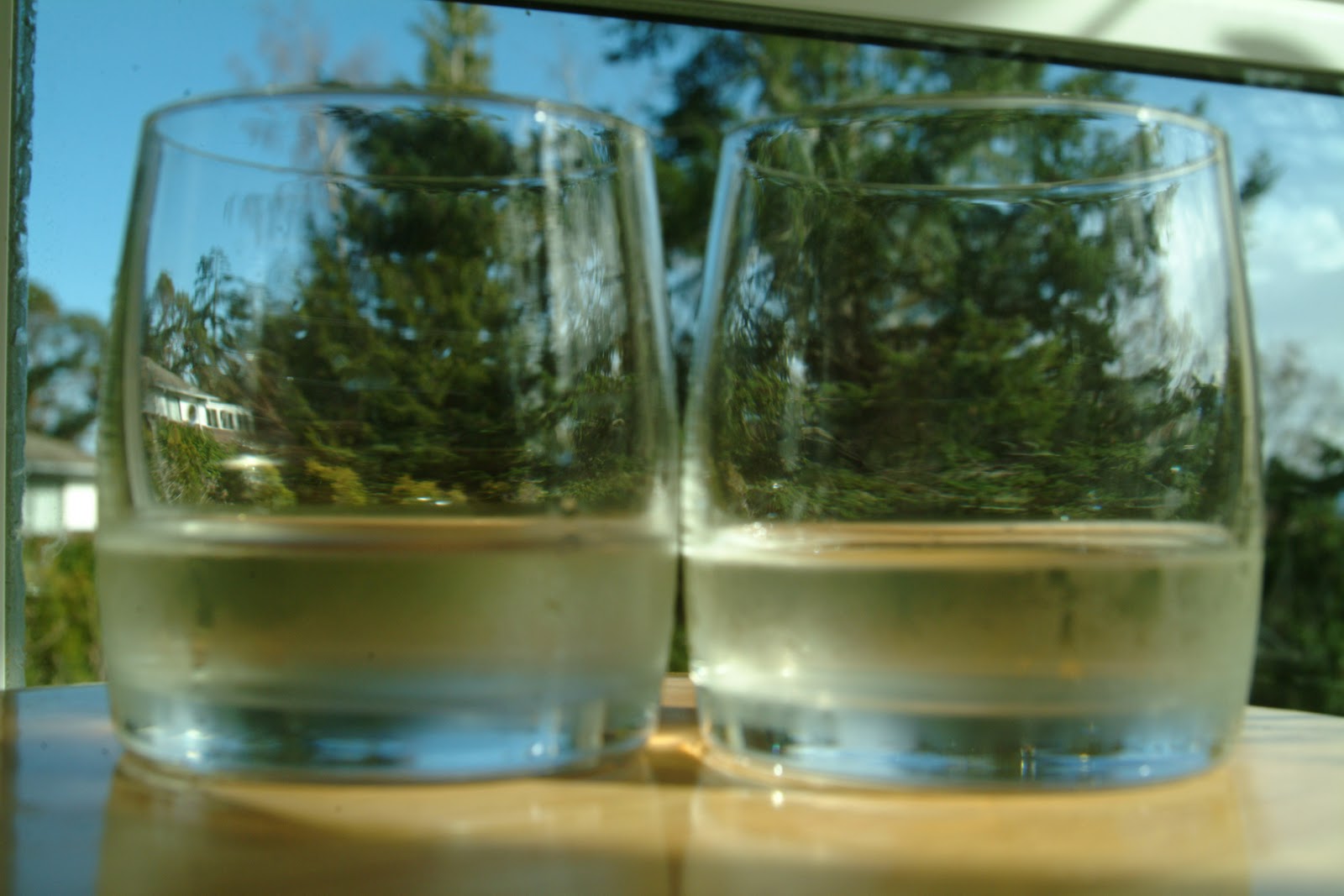
The glass on the left is vermouth stirred with the filtered ice and the glass on the right was stirred with double boiled ice.  As you can see there is a noticable difference in the volume of liquid but very negligible.  So the only thing to do now is to taste it. And was there a difference in taste?  The short answer is no, nor was there any noticeable difference in temperature.  The difference in taste was so insignificant that if you had two cocktails one after another, one being stirred with filter ice and the other with double boiled ice you would have not a clue the difference.  I then placed two ice balls in each glass and let them sit for 3 hours.  The final product of ice wasn't that different as you can see.
Filtered Ice ball left. Double Boiled Ball Right.

 There was although a drastic difference in the beginning product of the ice balls.  The double boiled ball was approximately 60-70% clear where as the filter ice was 15% at best.  So I thought, no one is going to be sipping vermouth through a straw from their undisturbed glass for 3 hours.  So for the sake of "Science" I painfully prepared two Old Fashioneds in the same fashion as the vermouth. The double boiled ball seemed to stay in one piece for the entirety of the swim, unfortunately the filtered ball didn't fare as well. Small ice chunks cracked off and eventually the entire sphere split in two and thus watering down the drink more then it's opponent.

So what's the end verdict?  In my opinion( keyword being "my", I am by no means a scientist or even a bartender) for small ice cubes, filtered water will suffice.  I do how ever think it makes a difference for big ice, whether you're freezing big blocks for cracking or just single spheres for sipping the dilution rate appears to be much slower then good ol' filtered water.  But remember this was clearly an experiment for my own pleasure and I thought it would make a good topic to blog about.  If you want to read a blog post about ice from a guy that REALLY knows what he's talking about check out Dave Arnold's (who happens to be a real scientist!) blog post on ice.