Showing posts with label Rye. Show all posts

Tuesday, 17 January 2012

Pre-Whisky Fest Fun: Day 4

Whisky Cocktails.  I could not think of two words that would make most whisky "aficionados" (AKA: Snobs) cringe more.  Even adding a cube of ice to a nice whisky is enough to raise the blood pressure of said "aficionados".  So it would come as no surprise if this following blog post gave a few people heart attacks, because this blog post is all about whisky cocktails!

Now before I begin, I do have one rules when making a cocktail with any spirit, not just whisky.  I'll never mix a spirit that I have to pay more than $80 dollars for.  To give you a good example of the ridiculous taxation on alcohol here in British Columbia, here are some very common bottles (750ml) and their prices:


  • Ballantine's Finest - $25.99
  • Glenfiddich 12 Year Old - $48.99
  • Highland Park 12 Year Old - $66.95
  • Laphroaig 10 Year Old - $84.99
  • Lagavulin 16 Year Old - $124.99
  • Macallan 18 - $249.99

Flower of Scotland
- 1 oz Glenfiddich 12 Year Old
- 1 oz Giffard's Ginger of the Indies
- 1 oz Noilly Prat Dry Vermouth
- 2 Dashes of Angostrua Bitters

- Add all ingredients to mixing glass
- Add ice and stir
- Strain into chilled cocktail glass
- Garnish with a flamed lemon zest


The idea behind this cocktail was to deconstruct the flavours present in Glenfiddich 12 year old (ginger, christmas spices, citrus), and highlight those particular flavours.

Blood and Sand
- 1 oz Blened Scotch
- 0.75 oz Cherry Herring
- 0.75 oz Sweet Vermouth
- 1 oz Orange Juice

- Add all ingredients to cocktail shaker
- Add ice and shake
- Double Strain into chilled cocktail glass
- Garnish with flamed orange zest

Blood and Sand
A favorite cocktail of mine, the Blood and Sand is a classic cocktail named after the equally classic 1922 movie of the same name.  

For this particular cocktail I like to use a blend with a pronounced smokiness, like Black Grouse.  I find that lightly smoky blends tend to get lost amounts all the other ingredients. 

One note about cherry herring, if you're like me and live in B.C. you probably know we can't get cherry herring here.  The best alternative is the cherry liqueur from Okanagan Spirits.

1806 Whisky & Cola
- 2 oz Bourbon
- 0.33 oz Kola Tonic
- 2 Dashes Chocolate Bitters
- 2 Dashes Fernet Branca

- At the bottom of a mixing glass muddle one large orange zest
- Add all remaining ingredients to mixing glass
- Add ice and stir
- Strain into chilled rocks glass with one large ice cube
- Garnish with flamed orange zest

1806 Whisky & Cola
An obvious twist on the Old-Fashioned, the 1806 Whisky & Cola is named after the year in which the word "Cocktail" was first defined in print.  If you are wondering what the hell kola tonic is, it is basically concerted cola syrup.  A quick google search of "Cola Syrup" will reveal various sites that carry the product.  If you are a B.C. resident, I suggest outofafricatrading.com. They are B.C. based so your product will arrive in no time. 

The Scofflaw
- 1.5 oz Rye Whisky
- 1 oz Dry Vermouth
- 0.75 oz Lemon Juice
- 0.75 oz Real Pomegranate Grenadine

- Add all ingredient to cocktail shaker
- Add ice and Shake
- Double Strain into chilled cocktail glass
- Garnish with a long thin lemon twist


Another classic prohibition era cocktail from Harry's New York Bar in Paris, The Scofflaw is a reference to the 20s term of the same name.  A "Scofflaw" was a term coined by the media to describe someone who enjoyed visiting his/her local speak-easy.

Sunday, 4 December 2011

Winter Warmers

It's December, and we are finally feeling the cold weather of winter.  While Mixologists like my self will still enjoy a well made Margarita or Caipirinha any time of the year, the rest of the population tends to take comfort in warmer libations.  So in the spirit of winter, here are some recipes that should keep you warm until the spring.

Hot Toddy
- 2 oz Irish Whiskey
- 0.75 oz lemon juice
- 0.25 oz honey
- Boiling Water

- Add Whiskey, lemon, and honey to teacup
- Top with hot water
- Gently stir to incorporate all ingredients
- Garnish with cinnamon stick, nutmeg, and lemon wheel


The Hot Toddy has been a home remedy for anything that ails you for centuries.  While it's origin and creator maybe unknown, one thing is for certain, it is a delicious way to warm the soul on a cold winter night.  As timeless as the Hot Toddy is, here is a slightly modern take on this classic.

Mornings in Normandy 
- 2oz Calvados
- 0.75 oz Lime Juice
- 0.25 Honey
- Hot Apple Cider

- Add Calvados, lime juice and honey to teacup
- Top with Hot Apple Cider
- Gently stir to incorporate all ingredients
- Garnish with cinnamon stick, and thinly slicked apple wheel


If you are looking for more of festive flavor, and not the physically warming effects of the toddy, give these drinks a try.

Autumn Old-Fashioned
- 1 oz Cognac
- 1 oz Cruzan Single Barrel
- 2 Dashes Boker's Bitters
- 0.25 oz Spiced Pumpkin Beer Syrup *
- Orange Zest

- Add orange Zest to the bottle of mixing glass
- Muddle orange zest with back end of bar spoon to extract oils
- Add all remaining ingredients to mixing glass
- Add ice to mixing glass
- Stir for 30 seconds
- Strain into rocks glass with one large ice cube
- Garnish with one cinnamon stick


Root-Beer Flip
- 2 oz Sazerac 6 Year old
- 0.5 oz Honey Cinnamon Syrup **
- 2 Dashes Bitter Truth Aromatic Bitters
- 1 Whole Egg
- 1.5 oz Philips Sarsaparilla

- Add all ingredients (except beer) to cocktail shaker 
- Dry Shake
- Add ice and shake
- Strain into chilled brandy snifter
- Top with Philips Sarsaparilla and nutmeg


If you don't live in B.C. and can't get Phillips Sarsaparilla, feel free to experiment with other sesanally appropriate beers available in your area; Innis & Gunn is a favorite of mine to use in cocktails.


Syrup Recipes 
Spiced Pumpkin Beer Syrup *
- 1 Cup Sugar
- 1/2 Cup Pumpkin Beer
- 8 Cinnamon Sticks
- 1 Teaspoon Fresh Ground Allspice
- 1/2 Teaspoon Anise Seed

- Add all ingredients to sauce pan over medium heat
- Constantly stir to dissolve sugar
- After approximately 10 minutes over medium heat remove pan from heat
- Allow syrup to cool
- Using a fine mesh strainer, skim the surface to remove foam
- Strain through a fine mesh strainer 
- Bottle and store in fridge

Honey Cinnamon Syrup **
- 1 Cup Honey
- 3/4 Cup Water
- 10 Cinnamon sticks

- Add all ingredients to sauce pan over medium heat
- Constantly stir to achieve an even consistency 
- After approximately 10 minutes over medium heat remove pan from heat
- Allow syrup to cool
- Remove cinnamon sticks from syrup
- Bottle and store at room temperature  

Friday, 18 November 2011

Mixology and Home Bartending for Beginners: Methods of Mixing

Well it about time that everyone who has been following this mini-series of blog posts finally learns how to actually make a drink.  So far we have covered, tools of the trade, stocking your home bar and the various non-alcoholic ingredients.  Now that you have your tools, booze, and mixes, we will learn the basic methods of mixing.

There are three basic methods to making drinks: building, stirring and shaking.

Building
Building is the most simple of techniques.  The biggest factor to consider when making a built cocktail is the type of ice you use.  The type of ice you use depends on three factors, alcoholic strength of the cocktails, level of desired dilution, and desired temperature.  With out going into the full details (which can be found in an early post here), ice with a large surface area (eg. crushed ice) will give more dilution and thus chill a drink more sufficiently.  The opposite applying for ice with a small surface area (eg. cube ice).

To make a built drink, simply add your base ingredients (spirits citric, syrups), then add your ice, top -if necessary- with addition carbonated ingredients (eg. soda, ginger beer).  Last, stir gently and garnish.  Here are two cocktails that utilize the technique of building.

Tom Collins
- 2 oz Gin
- 0.75 oz Lemon Juice
- 0.75 oz Simple Syrup
- Soda Water

- Add  Gin, lemon and simple syrup to collins glass
- Fill glass with cracked ice*
- Top with soda water
- Gently stir and garnish with a lemon zest** and straw


* Cracked ice is simply cubed ice that has been cracked into smaller pieces.  This can easily be done with your bar spoon by giving a cube of ice a swift smack.  For more on ice visit my last post for beginners, Ingredients.

** using a potato peeler, peel length wise a long strip of lemon.  Express oils over top of cocktail.  Clean up edges with a pairing knife and drop zest in glass.

Mojito
- 2 oz White Rum
- 0.75 oz Lime Juice
- 0.75 oz Simple Syrup
- 8 - 10 Mint Leaves
- Soda Water

- Add mint leaves to bottle of collins glass
- Very Gently, muddle mint to extract the oils from the leaves
- Add white rum, lime and simple syrup
- Fill glass half full with crushed ice and churn mixture
- Fill glass full with crushed ice
- Top with a splash of soda water
- Garnish with a massive sprig of mint, lime wheel and straw


The Mojito is one of the most bastardized cocktail around.  Here are some dos and don't of the Mojito.

DO: Use only fresh lime juice
DO: Use crushed ice
DO: Served this cocktail in a tall glass

DO NOT: Muddle the mint into a paste
DO NOT: Shake a Mojito.
DO NOT: Drown the cocktail with soda water

Stirring
It is a general rule that we stir drinks consisting only of clear ingredients (eg; spirits, bitters, syrups).  So your Martinis Manhattens, Sazeracs etc. are all stirred drinks.  There are several reasons as to why we stir a cocktails: presentation, texture, temperature and dilution.

It is a common saying that we eat with our eats.  That saying also applies to how we imbibe.  Take a look at the two pictures below.  To the left is a stirred Manhattan, and to the right is a Manhattan that has been shaken.  The stirred Manhattan will be perfectly clear, and the shaken Manhattan cocktail will have a slight haze.  Try this experiment at home for your self, you'll notice a major difference in look and mouth feel.

Manhattan
- 2 oz American Rye Whisky
- 1 oz Sweet Vermouth
- 2 Dashes Angostura Bitters

- Add all ingredients to mixing glass
- Add ice and stir for 30 seconds
- Strain into a chilled cocktail glass
- Garnish with an orange zest


If you were to taste the two side by side, the stirred cocktail has a silky texture, while the shaken cocktail is a bit more heavy in the mouth.  Shaking aerates the cocktail, resulting in a drastically difference mouth fell, which may be undesirable.


Pre-Prohibition Martini
- 2 oz Gin
- 1 oz Dry Vermouth 
- 1 Dash of Orange Bitters

- Add all ingredients to mixing glass
- Add ice and stir for 30 seconds
- Strain into a chilled cocktail glass
- Garnish with an lemon zest

Remember, keep your vermouth refrigerated!  If the level of the bottle reduces enough that you can transfer it into a smaller bottle, do so.  The less air in the bottle, the longer the vermouth will last.

While presentation and texture may come down to preference, dilution is the primary factor in why we stir.  Stirring is much less of a violent act than shaking, and thus dilutes the drink less.  One thing to remember is dilution = chilling.  A stirred drink will not be nearly as cold as the same drink that has been shaken.  It would take 2 minutes of stirring to achieve the level of dilution and chill that 15 seconds of shaking will achieve.

More information on the science of dilution and chilling can be found at Dave Arnold's blog Cookingissues.com

Shaking
Shaking is using for drinks containing fruit juice, cream, eggs, or any other ingredients that need to be thoroughly mixed into a drink.  You may stir drinks that contain fruit juice, (Never egg or cream!)  but the drink will not achieve the same consistency, texture and temperature that may be desired from a shaken drink.

Here are two drinks that should always be shaken:

Whisky Sour
- 2 oz Whisky (Your Preference)
- 1 oz Lemon Juice
- 0.5 oz Simple Syrup
- 1 Dash Angostura Bitters
- Egg White

- First add egg white to cocktail shaker. (In case you break the yolk or drop the shell in the shaker, you don't ruin the entire drink)
- Add all remaining ingredients to cocktail shaker
- Dry shake *
- Add cubed ice to shaker
- Shake for 15 seconds
- Double strain into chilled rocks glass **

* Dry Shake: A dry shake is a technique used for cocktails containing egg.  By adding the spring from a hawthorn strainer into the cocktail shaker (without adding ice), shake the cocktail for 10 seconds to whisk the egg white.  Then remove the spring and add ice.  Continue shaking as you would with any other cocktail.

**Double Strain: Use a tea strainer (aka, fine mesh strainer) to strain out any additional ice, bits of fruit, or any other undesirable debris.  This results in a drink with a smoother texture.  99% of all drinks I shake are double strained.  An sufficient alternative to double straining is pressing the gate of the hawthorn strainer closer to the edge of the shaker tin.  I use this technique for straining a Ramos Gin Fizz, which is the one shaken cocktail I do not double strain.


Brandy Alexander
- 1.5 oz Cognac
- 0.5 oz Creme de Cacao
- 1 oz Half & Half

- Add all ingredients to cocktail shaker
- Add cubed ice to cocktail shaker
- Shake 15 seconds
- Double strain into chilled cocktail glass
- Garnish with fresh grated nutmeg


If you are just discovering your love for cocktails and you still have questions in regards to any material, please do ask.  Additionally, if anyone has any suggestions for material that may be useful to cover in a future addition of Mixology and Home Bartending For Beginners, your input is greatly appreciated.

Thanks for reading.

Sunday, 16 October 2011

Art of The Cocktail 2011: Recap

This past weekend was host to Victoria's 3rd annual Art of The Cocktail.  Canada's first festival recognizing cocktail culture for more then just a vehicle for alcohol. This three day festival holds various seminars with some of the industry's brightest minds from the bar and spirit world.

Day one was a packed with events.  To begin, "A long and mysterious Histroy of Bitters" hosted by Manuel Dias Barreira on behalf of Bitter Truth.  Diving deep into the history of bitters, Manuel took us through the once medicinal nature of bitters, all the way to its current use in modern cocktails.  Along side, we talked about the various liqueurs equally rich in history, including: Benedictine and Chartreuse.  An array of recently reborn liqueurs courtesy of  bitter truth were sampled including, creme de violete, pimento dram, sloe gin, pink gin, apricot liqueur and Elixir, a sweet vermouth that rivals Antica Formula is quality. Those lucky enough to attend had the opportunity to purchase the Bitter Truth travel pack.


Next was the home bartender's competition. The theme of herbs resulted in five wonderful creations by five passionate cocktail enthusiasts.  For the competition I decided to focus on one main herb.  Thyme was the focal point of my cocktail. Detailed in a recipe below, "Caught Some Where in Thyme" incorporates several advance techniques resulting in a classic style cocktail with a few modern twists.  This was my first competition, while I was expecting a larger crowd, similar to last year's professional bartender's competition, it was some what of a relief to only have to compete in front of 20 or so people.  To judge the performance and cocktails of the participants were; Simon Ogden, head bartender of Veneto Tapa Louge, Darcy O'neil, molecular pathologist, author of fix the pumps and website, Art of Drink, lastly, Peter Hunt, master distiller of Victoria Spirits rounded off the judging panel.  Here is a look at my performance for the event.


Caught Somewhere In Thyme
- 1.5 oz Sazerac 6 Year Old
- 0.75 oz Thyme & Lemon Infused Dry Vermouth
- 0.25 oz Strega
- 0.25 oz Thyme Syrup *
- 2 Dashes Peychaud's Bitters
- Thyme Lemon Foam **
- Absinthe


- Toast thyme on wooden plank (or cutting board) with absinthe
- Cover smoked time with cocktail glass
- Add all liquid ingredients to mixing glass
- Add ice and stir
- Strain into smoked cocktail glass
- Add a 1/2 inch layer of thyme lemon foam
- Garnish with fresh sprig of thyme


Janice Mansfield, owner of House Made won over the judge's palates with her cocktail, Healthy, Wealthy and Wise.  An in-depth round up of Janice's cocktail can be found at her blog, Housemade.ca

Thyme Syrup *
- Place 2 cup of water and 2 cups of thyme (whole) in a pot over medium heat
- Boil thyme water until water has turned a green hue
- Strain out time
- Place 1 cup (make sure you have some thyme water left over, you need it for the foam) and 1 cup sugar in a pot over low heat until all sugar has dissolved
- Let cool, bottle and refrigerate

Thyme Foam **
- 6 oz Thyme Syrup
- 3 oz Lemon Juice
- 2 oz Thyme Water
- 4 Eggs Whites
- 1 Packet of Whip It, Whip cream stabilizer

- Dissolve whip it in lemon juice and syrup
- Add all ingredients to isi whip cream maker
- Double charge and chill for a minimum of 2 hours


The evening ended with the grand tasting.  Hundreds poured into Crystal Gardens in downtown Victoria to taste the best food and drink the west coast has to offer.  A few memorable sips came from the CPBA booth, Cariel Vodka and Solomon Siegel's Riato, a mixture of gin, lychee liqueuer, lemon juice, lapsang souchong syrup and chocolate bitters.

Day two begin with my absolute favorite presenter and personality, Philip Duff.  Boarding on a mixture of a standup routine and informative seminar, Philip's "Going Against the Grain" allowed us to taste strain corn, wheat, rye, malted barley distilled along with spirits incorporating them.  Some of the highlights of the seminar included the opportunity to taste old pure malt Geneva and a recreation of Irish whisky from the 1800s.

Pur Malt Geneva

To cap off the day, a panel discussion of in-house vs. Store bought products was debated between Danielle Tatarin of Keefer Bar, Trevor Kallies of the Donnelly Group, Cameron Bogue of Earl's New York and Craig James of Fetimains Cola.  All participates brought up valid point on both sides of the argument, including: health and safety of customers, consistency and final cost (calculating time and product cost to make things such as house made ginger beer and syrups.)  While it may be difficult to win over a room full of bartenders, Craig of Fetimians brought up some very valid points.  In the end everyone agreed that a balance of house made and pre-bought is necessary.  After all,  Fetimians does make superb products, of which the ginger beer and tonic water are two I always keep on hand.

Art of The Cocktail G&T
- 2 oz G'Vine Floraison
- 0.25 oz Lime Juice
- 1 Dashes Bitter Truth Celery Bitters
- 4 oz Fetimians Tonic water

- Add all ingredients to a highball glass filled with cracked ice
- Gently stir to combined ingredients
- Garnish with lime twist


The last seminar of the weekend was hosted by Ron Cooper of Del Maguey Single Village Mezcal.  "The spirituality of Mezcal" included a tasting of Del Maguey Vida and five single village mezcals.  Ron detailed the production of each mezcal along with various stories, including how he fell in love with mezcal and a brief history of distillation in Mexico.  To learn more about some of these single Mezcals, here is a link to a tasting I participated in at Clive's this past July.  Mezcal Tasting

Ron Cooper of Del Maguey


The event Art of The Cocktail indefinitely ended with a bang, flames and all.  This event was the Professional Bartender's Competition.  Nine bartenders from across the northwest took to the stage at the Veneto Tapa Lounge to display their most innovative creations utilizing the theme of "Farmer's Market Fresh."  After nine creative concoctions were presented to the four judges the three medalists were announced.  In 3rd place, Ryan Malcolm of Glo with a twist of the Old Fashioned that included vodka and a blueberry eau de vie of questionable legality.  2nd went to Nate Caudle of Clive's Classic Lounge with his carbonated bottled cocktail, Old Thyme Prairie Berry Fizz .  In 1st place, Josh Boudreau of Veneto Tapa Lounge took home the gold this his cocktail "The Headless Horseman".

Veneto's Josh Bourdreau

Old Thyme Prairie Berry Fizz (Nate Caudle)
- 1 oz Dobonnet Rouge
- 1 oz Thyme Infused Tanqueray
- 1 oz Lemon Juice
- 1 oz Sweetened Saskatoon Berry Juice
- 1 oz Water

- Build in perlini system over ice
- Carbonate perlini system with C02 Charger until full
- Shake
- Let settle for minimum 10 seconds
- Unscrew cap of perlini to release gasses
- Pour into Vessel of Choice

*Recipe courtesy of Clivesclassiclounge.com


The weekend undoubtedly stood up to my expectations.  Exceptional seminars, a fabulous grand tasting and great drinking company made for a unforgettable weekend (not many can say the same considering some of the nasty hang-overs that ensued).  Thanks most of all to those at Art of The Cocktail who helped assemble an outstanding event.

Sunday, 28 August 2011

Blind Tasting: American Rye

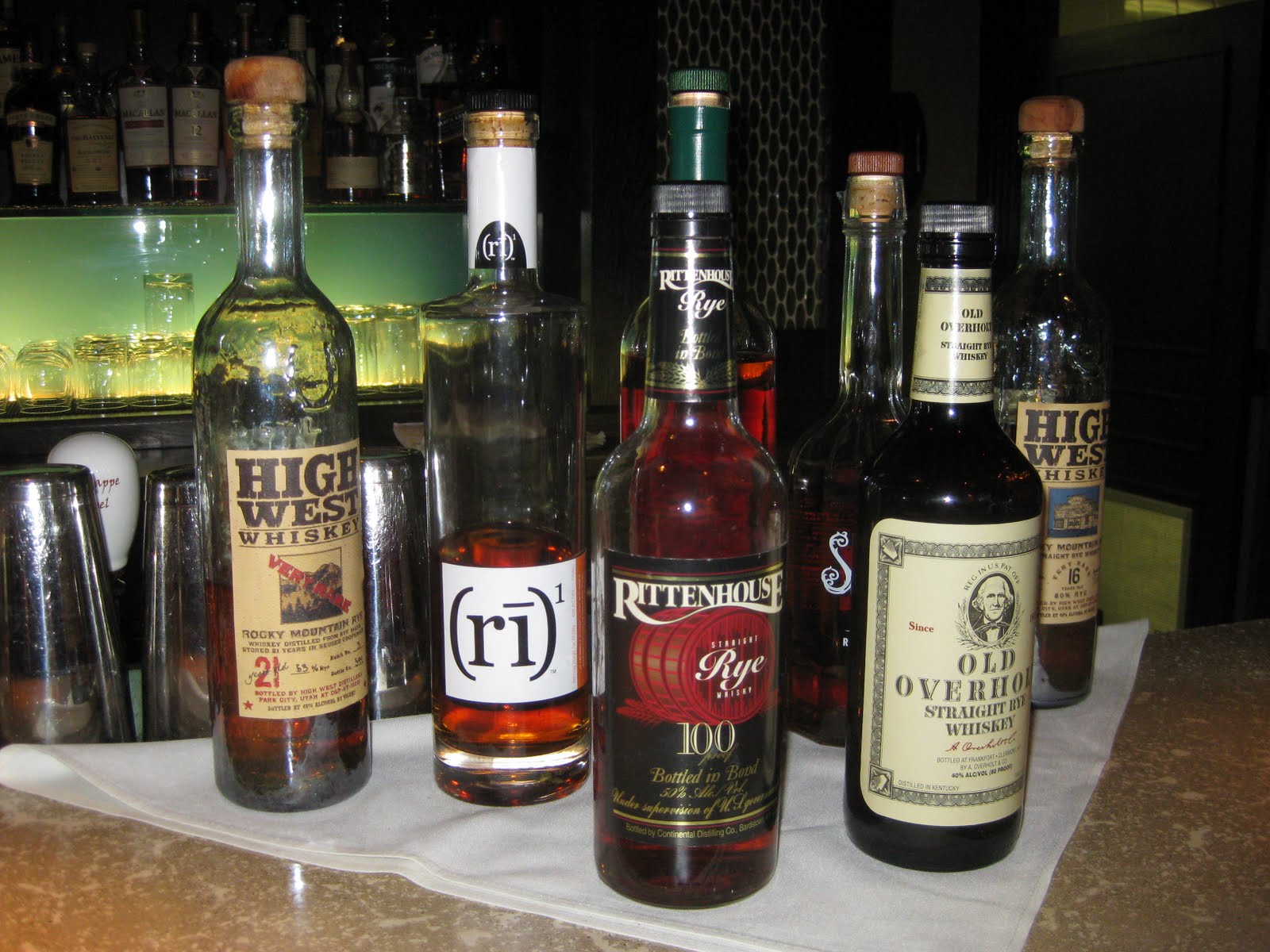
American Rye plays a major role in the early history of american cocktails and distillation.  When Scottish and Irish settlers of the 1600's began their new lives in Colonies of Pennsylvania, Maryland and the Carolinas they faced a major dilemma.  A lack of whisky.  With the vast abundance of rye it only made sense to apply their skills of whisky making to this new crop.  Rye continued to be the whisky of choice for Americans until the enactment of the volstead act in 1919 which nearly abolished all traces of this tipple.  With in the last 5 years people have been beginning to realize that rye whisky is more then just a misnomer for canadian whisky.  A renaissance of rye is currently in full force.

Earlier this summer in July I attended an evening of imbibing on mezcal at Clive's Classic Lounge here in Victoria B.C.  With the recent success of that night a new monthly event has been spawned.  Clive's Tasting Panel is a ticket only event limited to 12-15 people.  The tasting panel has the opertunity to taste some of the best spirits available in their category.  For the first month of the tasting panel American Rye was the featured spirit.  The whiskies to sample were as followed

Sazerac 6 Year Old
Distilled at: Buffalo Trace
ABV: 45%
Price: $50
Rye Content: N/A


Sazerac 18 Year Old
Distilled at: Buffalo Trace
ABV: 45%
Price: $180
Rye Content: N/A


Rittenhouse 100 Proof
Distilled at: Heaven Hills
ABV: 50%
Price: $45
Rye Content: 51%


RI 1 Rye
Distilled at: Jim Beam
ABV: 46%
Price: $50
Rye Content: N/A


Old Overholt 4 Year Old Rye
Distilled at: A. Overholt & Co.
ABV: 40%
Price: N/A Not Available in B.C.
Rye Content: N/A


High West 16 Year Old
Distilled at: Former Seagrams Distillery, Lawrenceburg, IND
ABV: 46%
Price: N/A Not Available in B.C.
Rye Content: 80%


Hight West 21 Year Old
Distilled at: Former Seagrams Distillery, Lawrenceburg, IND
ABV: 46%
Price: N/A Not Available in B.C.
Rye Content: 53%


The whiskies were placed in no particular order and were rated on; appearance, aroma, taste and finish.  I have a few believes when rating a spirit.  To begin I don't rate on appearance.  We live in a fake world.  Fake hair, fake tans, fake tits and fake colored whisky.  While I am not aware of any laws regulating coloring for American Rye Whisky, but I do know is that I have tasted enough whisky colored with E150 to realize that not all spirits show their true colors.  So with that being said everyone gets a 5 out of 5 for appearance!


Another note. I like to take time to get to know my whisky.  I could have spend an hour per whisky, discovering all the small nuances and qualities that each whisky has to offer.  I can never give a final verdict on a whisky until I've gotten to know it.  Like a beautiful women you need to take her out on more then one date to decide if she's marriage material.  With that being said, I am open to giving any of these whiskies a second chance.


Tasted from bottom left to bottom right in clockwise order.

With only 2.5 - 3 hours of tasting I concluded with the following scores along with a few tasting notes. 


Old Overholt 4 Year Old Rye
Appearance: 5
Aroma: 3.5
Taste: 3
Finish: 2
Total: 13.5


While Old Overholt still has a obvious youth it is by no means a bad whisky. Cinnamon, clove, oak and campfire ashes make for a fairly pleasant nose.  The tastes follows the same path as the nose but unfortunately a weak finish results in a whisky better suited for mixing.

Rittenhouse 100 Proof
Appearance: 5
Aroma: 3
Taste: 4
Finish: 3
Total: 15

The aroma of pears, coffee and antique shops (yes...antique shops)  is initially over powered by the sharp smell of alcohol.  A small edition of water help open this whisky up to a salty, herbal dram with notes of licorice, oak and molasses.  Decent finish but fades within a short period of time.

High West 16 Year Old
Appearance: 5
Aroma: 4
Taste: 5
Finish: 4
Total: 18

I'd like to thank who ever decided to put these barrels of whisky away 16 years ago.  A massive blast of rye results in a wonderfully balance whisky containing carmel, raisins coconut, black pepper cinnamon along with countless other notes.  Strong spicy finish that lasts long after the glass is empty.

Sazerac 18 Year Old
Appearance: 5
Aroma: 4
Taste: 4
Finish: 5
Total: 18

There is a reason why Jim Murray has rated the Sazerac 18 year old in the 90 every year since this rye's inception.  A slightly sweet rye with notes of vanilla, raisins, carmel, mint, anise and juniper.  While it scored the same as the High West 16 year old I would have to claim the Sazerac 18 year old as my favorite whisky of the evening.

RI 1 Rye
Appearance: 5
Aroma: 5
Taste: 3.5
Finish: 5
Total: 17.5


They need to make candles that smell like this whisky!  Without a doubt the best nose of all the whiskies.  Lots of berries (strawberry, black, blue), cupcakes, vanilla in the nose.  Unfortunately the taste is what keeps Ri 1's from being an amazing whisky.  Light and fruity on the palate with a slight spice.  The finish more then makes up for the taste.  Long subtle fruits, christmas spice and a prominent banana after taste makes this a very memorable whisky.

Sazerac 6 Year Old
Appearance: 5
Aroma: 4
Taste: 3
Finish: 3
Total: 15


Sazerac 6 year old is what you imagine a rye should taste like.  Cinnamon, allspice, black peppers and other all a spicy whisky.  A subtle sweetness of chocolate and vanilla notes round this whisky off with a solid equilibrium.  While still a little rough around the edges, Sazerac 6 year old is a great whisky which makes an even better Manhattan.

Hight West 21 Year Old
Appearance: 5
Aroma: 2.5
Taste: 3
Finish: 3
Total: 13.5

I found my self disappointed with this whisky.  High West 21 year old lacks the back bone of most rye whiskies.  Flavors are more subtle, with more time I may be able to better appreciate this whisky but when stood next to Sazerac 18 year old and it's younger brother the 16 year old High West it falls short of noteworthy.   On the nose, tabacco, vanilla, oak.  Slight honey sweetness and spices on the palate.  Very week finish, diminishing rapidly.


The evening was alot of fun.  Not a serious tasting of pretentious whisky "Aficionados" displaying a pissing contest of the palate.  Just a regular group of people with a passion for spirits and a desire to broaden their knowledge.  Lastly I'd Like to thank Shawn Soole of Clive's Classic lounge for hosting, I look forward to future tastings... Especially the Tequila and Scotch tastings.

Thursday, 4 August 2011

Classic Cocktail of The Month: Twelve Mile Limit

Prohibition was both detrimental and beneficial to the cocktail culture.  Bartenders across the USA left for Europe, Canada and Cuba.  The majority of those who remained went to work in soda fountains.  Few foolishly worked illegally in speak-easys serving liquor so foul you wouldn't be cruel enough to serve it to your in-laws.  It was however the cause of many memorable cocktails, the Bee's Knees, Southside, Colony Cocktail etc. All of which share a simple formula. spirit, sugar and citrus. Due to the quality of much of the alcohol being produced at the time, this equation of imbibing was formulated to mask the terrible quality of the hooch.  But, those wishing to sip on a spiritous cocktail didn't have to travel far or risk blindness from bathtub gin.  Once 12 mines off the shore of the United States the Volstead act was void.  To toast this legal loop hole two cocktails may be found published in print.  In the 1930's Savoy Cocktail book by Harry Craddock is the "Twelve Miles Out".  A simple mixture of equal parts White Rum, Swedish Punch and Calvados.  Secondly you may find a recipe by the name of "Twelve Mile Limit" in a publication of a 1934 newspaper article.  In said article Tommy Millard is credited with creating the Twelve Mile Limit.  While extraordinarily similar in name, the cocktails share only one ingredient and are otherwise completely different tipples.  Whether Mr. Millard was aware of the previous publication of the Twelve Miles Out is unaware.  But It would not seem unlikely that more then one human being celebrated the act of legal libations during prohibition by creating a cocktail.

Twelve Mile Limit
- 1 oz White Rum
- 0.5 oz Rye Whisky (Preferably use a spicy American Rye Like Rittenhouse or Sazerac)
- 0.5 oz Cognac
- 0.5 oz Grenadine
- 0.5 oz Lemon Juice

- Add all ingredients to cocktail shaker
- Add ice and shake
- Double strain into chilled cocktail glass
- Optional garnishes include a lemon twist, lemon wheel or brandied cherry


Essentially the Twelve Mile Limit is a sour, Spirit(s), citrus and sugar.  For my variation on this cocktail I didn't dive off into the deep end with an obscure variation.  I stuck fairly close to shore while still straying far enough away from the Original Cocktail to have a personality all of it's own.

Shore Line
- 0.75 oz White Rum
- 0.75 oz Calvados
- 0.5 oz Bourbon
- 0.5 oz Agave Nectar
- 0.5 oz Lime Juice

- Add all ingredients to cocktail shaker
- Add ice and shake
- Double Strain into chilled cocktail glass
- Garnish with lemon twist*

* Yes Lemon.  Garnishing a cocktail with a ingredient that is not present in the liquid is a technique know as "Flavor Tripping".  Because 70% of what you tastes is perceived by what you smell you are tricked into thinking there is lemon in this cocktail.
Shore Line
Just a reminder.  The prepose of me doing a variation on these cocktails is to demonstrate that having a deep repertoire of classics may greatly help improve your ability to create and improvise your own libations.  The Shore Line has to be one of my favorite cocktails to surface since the inception of this segment, Classic Cocktail of The Month.  If possible give both a try while the summer weather is still around.