Saturday, 4 February 2012

Victoria Whisky Festival 2012: Recap

Last weekend was the 7th annual Victoria Whisky Festival.  Companies from Scotland, Ireland, Indian, American, and even British Columbia all gathered to show case their best whiskies.

Thursday January 19th

The Thursday evening kicked off the festival with a tasting hosted by the world renown Jim Murray.  Having never been to a tasting with Jim before, I honestly had no idea what to except.  Walking into the room, the fragrances of over 1000 glasses of whisky wafted through the air like a delicate perfume.  Upon taking my seat I was both excited and terrified; 13 glasses of whisky sat in front of us.

Walking us through every whisky one-by-one, Jim had a story to go along with every one of the great whiskies he had chosen.  

Thirteen Stunning Whiskies
With out reveling too much -wouldn't want to possibly ruin the surprise of a future Jim Murray tastings-, the whiskies ranged in price from $23.75 - $350, and included whisky from five different countries.

Ok, I'll let you know my three favorites of the tasting, but no more information!


  • Amrut Intermediate Sherry
  • George T. Stagg
  • Old Pulteney 21 Year Old

Friday January 20th

The following night was host to five grand tastings: Amrut, Balvenie, Canadian Club, Isle of Arran, and Laphroaig.  Being that I am a peat-oholic, I chose to attend the Laphroaig grand tasting hosted by master ambassador, Simon Brooking.

If you remember the first post in my "Pre-Whisky Fest Fun" series, you'll remember my predictions for the Laphroaig line up: Quarter Cask, 10 Year Old, Triple Wood, Cairdeas, and 18 Year Old.  Well I got 4/5.  The bottle I was very pleasantly surprised to see was the Laphroaig 25 year old cask strength edition!


While the Quarter Cask and the 10 year old displayed typical Laphroaig characteristics of bbq, seaweed, and of course, loads of peat, the Triple Wood, Cairdeas, and 25 year old displayed some wonderfully unique complexities that I've yet to taste from any other Laphroaig.

The Laphroaig Triple Wood is essentially the Quarter Cask finished in sherry butts.  On the nose of the Triple Wood, a sweet barley aroma along with raisins, dark chocolate, vanilla, and the slightest hint of smoke can be detected.  The taste is equally complex and delicate as the nose.  light peat, figs, raisins, and a touch of saltiness.  The finish is long and gentle with a hint of smoke.  Not very "Laphroaig" by tradition, but an exceptional dram none the less.


Laphroaig's annual Fèis Ìle bottling, Cairdeas (Gaelic for "friendship"), is a Laphroaig that is slightly more akin to the regular expressions from Laphroaig, but with some slight flavor twists.  A vatting of whiskies of various ages, this year's bottling of Cairdeas is dubbed the "Ileach Edition"  or "native of Islay" in Gaelic.  The nose is full of typical Laphroaig notes of peat, smoked bacon. bbq, smoked salmon; and a touch of vanilla and icing sugar sweetness.  The palate is full on Laphroaig: leather, shoe polish, band-aids, heavy peat smoke and a touch of banana.  The finish is medium in length with moderately intense peaty note.  This year's bottling of Cairdea does seem to be considerably younger than previous bottling, as well as being bottled at a lower ABV than previous year.  Although still an exceptional whisky, not quiet as exceptional as its predecessors.


To conclude the tasting, the Laphroaig 25 Year Old Cask Strength.  What a whisky!  Laphroaig is know for being a take no prisoners, balls to the wall, peat monster.  This whisky is anything but that.  After 25 years in the barrel the peat has subdued and notes of blackberry, figs, dark chocolate, maple sugar, pineapple and lavender take front stage on the nose.  The palate is equaliy complex with noes of tabbacco, leather, orange zest, basil, and a slightly peaty/salty characteristic.  The finish is long and gentle with notes of sweet vanilla and the slightest hint of smoke.
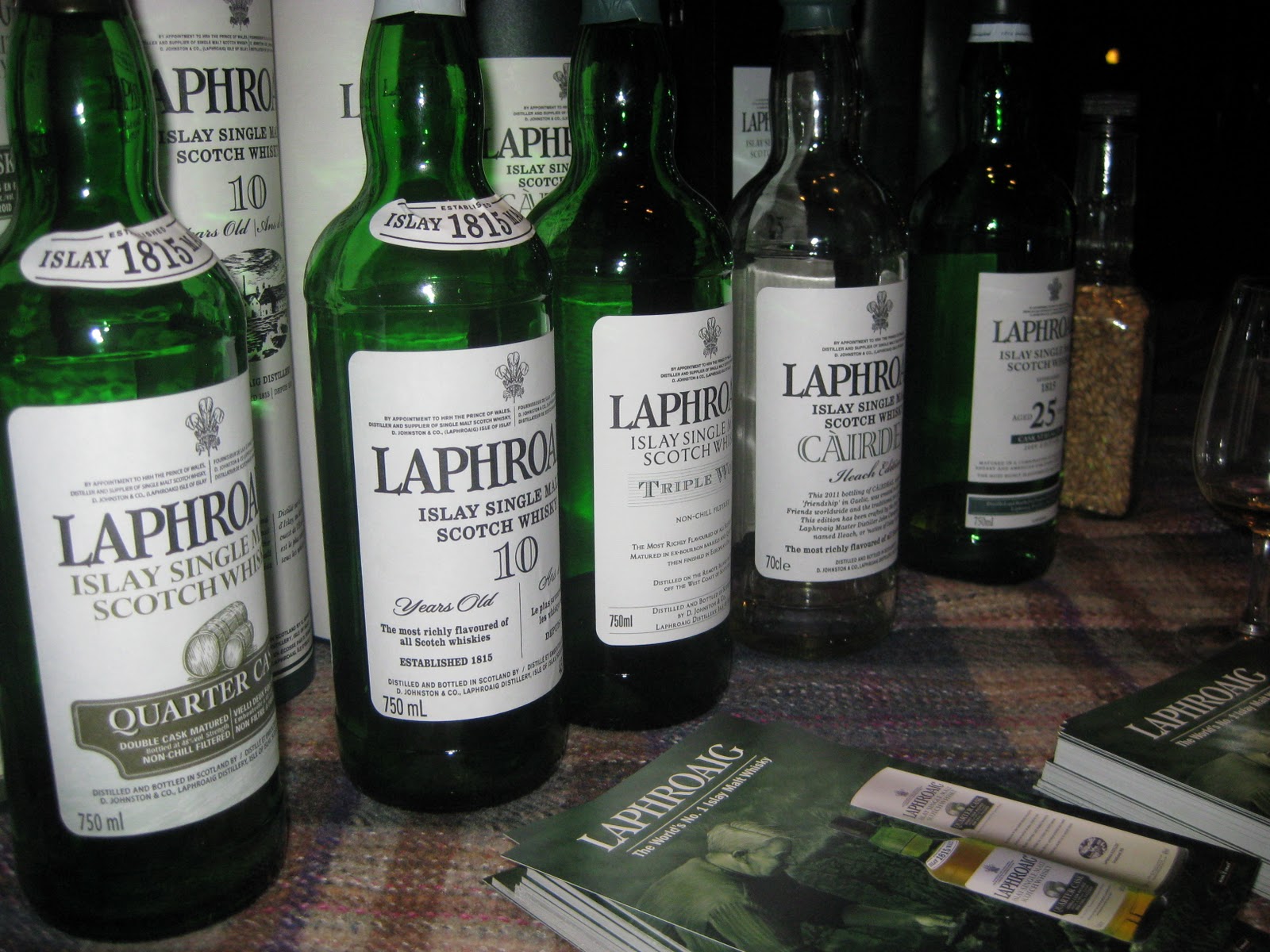

In addition to some exceptional whisky, Simon also brought some some items of interest including peat from Islay, and malted barley from the Laphroaig distillery.
Fresh and dried peat from the peat bogs of Islay


Saturday January 21st


Saturday kicked off with three master classes: Gordon & MacPhail, Glenfarclas, and Balvenie.  My first master class -Gordon & MacPhail- was really the wild card of the weekend. I had no idea what to expect.  I sat down to see six whiskies to welcome me: Benromach 10 Year Old, Glen Grant 1996, Mortlach 21 Year Old, Linkwood 25 Year Old, Benromach 30 Year Old, and a "suprise sample"

Absoultly ever whisky at the Gordon & MacPhail master class was a lovely whisky, in particular the Mortlach 21 Year Old and the Benromach 30 Year Old.

The Mortlach 21 Year Old had a wonderful nose of pears, bannana, apple, and butterscotch.  On the palate were notes of pears, white pepper, vanilla, and a hint of smoke.  The finish was the real star aspect of this whisky.  Notes of rich dried fruit and light peat smoke, accompanied by an ever developing finish resulted in a very memorable dram.

Winner of the best single malt (Multi cask) ages 28 - 34 in the 2012 Whisky Bible, the Benromach 30 Year Old is a knock out malt!  The nose is very complex with notes of vanilla, chocolate, raisins, cinnamon, orange zest, candy floss, and pears.  The tastes is equally enticing.  Chocolate, pecans, apples, cinnamon, and a slight hint of peat.  The Benromach 30 finishes long and rich, with notes of carmel, nutmeg, a touch of peat, and more chocolate.

You're probably wondering what the "special sample" was.  So were all of us in the master class.  After nosing and tasting for a few minutes a few of us came to the conclusion that it was a Glenlivet, approximately 25 years old.  A very good guess, but only 45 years too young.  It was the Glenlivet Generations 70 Year Old!  Distilled in 1940 and bottled in 2010, this whisky defies all logic.  After 70 years of aging in a first fill sherry butt you would expect it to tasted over sherried and over oaked.  That was certainly not the case.  While I was in a state of amazement, I was able to take brief tasting notes.  The nose was very complex with notes of nutmeg, eggnog, leather, carmel, figs, raisins, orange zest and tobacco.  The palate in so rich with dried fruit, carmel (not the nasty E150 kind), and a touch of peat.  The finish is long and rich with a big note of milk chocolate.  This was with out a doubt the best single malt I have ever taste.  Unfortunately at $22 000 a bottle it is a bit out of my price range.


My next master class was hosted by one of my favorite speyside distilleries, Glenfarclas.  Hosted by George Grant, George walked us through a tasting of the 8, 15, 17, 21, 25, Cask Strength 105, and Family Cask 1997.  My favorites from this master class were the 8 Year Old, the 15 Year Old, and the Cask Strength 105.  The 8 Year Old was very fruity.  Candied green apple, apricot, as well as some citric notes.  The finish was medium in length with lots of apple notes.  I couldn't think of a more ideal summer whisky.  The 15 Year Old was rich and sweet with notes of chocolate, toffee, banana, mocha, and a hint of salt.  The finish was rich with notes reminiscent of chocolate covered almonds.  The Cask Strength 105 was a cracker of a whisky, and one of my favorites of the weekend.  On the nose was a great complexity of vanilla, plum, walnuts and again, a hint of salt.  The taste was fruit with notes of pear and apple along with rich sherry characteristics. The finish, oh the finish!  Loooooong and rich!


The final master class of the evening was hosted by Sam Simmons, master ambassador of The Balvenie. This master class had the most unique, approach of the weekend.  Rather than just a tasting of the basic line up, Sam deconstructed the three elements that make up The Balvenie 12 Year Old Signature.  A vatting of 1st fill and 2nd fill bourbon, and 1st fill sherry.  In addition to a cask sample from each element of the 12 Year Old Signature, we all tasted the Signature itself, new makes spirit at still proof, and The Balvenie 30 Year Old.  With already two master classes worth of whisky in me all ready, I decided to bottle up all my samples from The Balvenie class im my 25ml sample bottles that I brought to the festival.  So look forward to a blog post on the deconstruction of The Balvenie 12 Year Old Signature, and proper tasting notes from The Balvenie 30 Year Old.

The best news I heard from the seminar was that, starting later in 2012, The Balvenie will be taking the no coloring, not chill filtration, 43% ABV, approach to making their whisky!


After three amazing master classes It was time for the grand tasting.  Not much to explain with this event, I walked around and tasted lots of whiskies.  So here are some photos from the evening.
Some exceptional Japanese Whiskies from Nikka
JD's new make spirit before and after charcole 


Victoria Spirit's "Craigdarroch" work in progress single Malt Whisky


A "Under the Table Treasure"


Another "Under the Table Treasure"


After tasting well over 100 whiskies on what could be the best weekend of 2012, I have come to the conclusion on my 10 Ten Whiskies of The Weekend.


  • 10. Glenfarclas 40 Year Old
  • 9. Glenrothes 1975
  • 8. Glenfarclas 105 Cask Strength 
  • 7. Springbank 18 Year Old
  • 6. Laphroaig 25 Year Old Cask Strength 
  • 5. Benromach 30 Year Old
  • 4. Old Pulteney 21 Year Old
  • 3. Tullibardine 1962 49 Year Old
  • 2. George T. Stagg Bourbon
  • 1. Gordan & McPhail 70 Year Old Glenlivet


Tuesday, 17 January 2012

Pre-Whisky Fest Fun: Day 4

Whisky Cocktails.  I could not think of two words that would make most whisky "aficionados" (AKA: Snobs) cringe more.  Even adding a cube of ice to a nice whisky is enough to raise the blood pressure of said "aficionados".  So it would come as no surprise if this following blog post gave a few people heart attacks, because this blog post is all about whisky cocktails!

Now before I begin, I do have one rules when making a cocktail with any spirit, not just whisky.  I'll never mix a spirit that I have to pay more than $80 dollars for.  To give you a good example of the ridiculous taxation on alcohol here in British Columbia, here are some very common bottles (750ml) and their prices:


  • Ballantine's Finest - $25.99
  • Glenfiddich 12 Year Old - $48.99
  • Highland Park 12 Year Old - $66.95
  • Laphroaig 10 Year Old - $84.99
  • Lagavulin 16 Year Old - $124.99
  • Macallan 18 - $249.99

Flower of Scotland
- 1 oz Glenfiddich 12 Year Old
- 1 oz Giffard's Ginger of the Indies
- 1 oz Noilly Prat Dry Vermouth
- 2 Dashes of Angostrua Bitters

- Add all ingredients to mixing glass
- Add ice and stir
- Strain into chilled cocktail glass
- Garnish with a flamed lemon zest


The idea behind this cocktail was to deconstruct the flavours present in Glenfiddich 12 year old (ginger, christmas spices, citrus), and highlight those particular flavours.

Blood and Sand
- 1 oz Blened Scotch
- 0.75 oz Cherry Herring
- 0.75 oz Sweet Vermouth
- 1 oz Orange Juice

- Add all ingredients to cocktail shaker
- Add ice and shake
- Double Strain into chilled cocktail glass
- Garnish with flamed orange zest

Blood and Sand
A favorite cocktail of mine, the Blood and Sand is a classic cocktail named after the equally classic 1922 movie of the same name.  

For this particular cocktail I like to use a blend with a pronounced smokiness, like Black Grouse.  I find that lightly smoky blends tend to get lost amounts all the other ingredients. 

One note about cherry herring, if you're like me and live in B.C. you probably know we can't get cherry herring here.  The best alternative is the cherry liqueur from Okanagan Spirits.

1806 Whisky & Cola
- 2 oz Bourbon
- 0.33 oz Kola Tonic
- 2 Dashes Chocolate Bitters
- 2 Dashes Fernet Branca

- At the bottom of a mixing glass muddle one large orange zest
- Add all remaining ingredients to mixing glass
- Add ice and stir
- Strain into chilled rocks glass with one large ice cube
- Garnish with flamed orange zest

1806 Whisky & Cola
An obvious twist on the Old-Fashioned, the 1806 Whisky & Cola is named after the year in which the word "Cocktail" was first defined in print.  If you are wondering what the hell kola tonic is, it is basically concerted cola syrup.  A quick google search of "Cola Syrup" will reveal various sites that carry the product.  If you are a B.C. resident, I suggest outofafricatrading.com. They are B.C. based so your product will arrive in no time. 

The Scofflaw
- 1.5 oz Rye Whisky
- 1 oz Dry Vermouth
- 0.75 oz Lemon Juice
- 0.75 oz Real Pomegranate Grenadine

- Add all ingredient to cocktail shaker
- Add ice and Shake
- Double Strain into chilled cocktail glass
- Garnish with a long thin lemon twist


Another classic prohibition era cocktail from Harry's New York Bar in Paris, The Scofflaw is a reference to the 20s term of the same name.  A "Scofflaw" was a term coined by the media to describe someone who enjoyed visiting his/her local speak-easy.

Monday, 16 January 2012

Pre-Whisky Fest Fun: Day 3

In the single malt world, alot of emphasis is put on the proof.  It is very common to hear a whisky expert say something along the lines  of, "This whisky could be greatly improved by being bottled at 43% ABV.", when reviewing a whisky bottled at 40% ABV.

So why not prove if there is any truth to this theory.  I have two near identical bottling.  Both produced by Laphroaig and bottled at 10 Years of age.  The only differences being one is bottled at 40% ABV and the other at 43%AB.

I will review both whiskies based on four attributes: aroma, taste, finish, and complexity in order to determined if a mere 3% alcohol makes any noticeable differences.  Each category will be rated out of 25 for a total score out of 100.

Laphroaig 10 Year Old 40%

Aroma: No too complex on the nose.  Typical Laphroaig notes of peat and seaweed, as well as nuances of red bell pepper, ginger, straw and a touch of sweetness.  The lack complexity and ability to develop in the glass hurts the potential for a higher score.

21/25

Taste: Beyond the peat and earthly characteristics are notes of basil, citrus peel, anise, burning rubber, BBQ, dark coffee, and a touch of sweet barley.  The taste is definitely the best feature of this whisky.  A good amount of complexity and balance of flavors gives it a very respectable score.

24/25

Finish: Unfortunately the finish is were this Laphroaig falls short.  Considering this is an Islay bomb, the finish is far too short and lacks any depth of complexity.  It's a rush of peat smoke with subtle salty background notes, and then it's gone.

20/25

Complexity:  Over all, the complexity of this Laphroaig 10 was fairly reasonable, although the absence of complexity in the nose, and finish really hold this back from being a superb whisky.

21.5/25

Total: 86.5/100


Laphroaig 10 Year Old 43%

Aroma: The peat is much more integrated and balanced on this one.  Lots of subtle notes of green bell pepper, seaweed, new band aids (yes, new band aids), black pepper and sea salt, as well as a aroma reminiscent of fine Mezcal.  More  Complexity on the nose then the predeceasing 40% Laphroaig, as well as a better balance allow for a higher score for this Islay malt.

22.5/25

Taste:  More typical Laphroaig: huge peat smoke, basil, black pepper, smoked fish, anise, dark chocolate, and a blast of fresh espresso; what a refreshing surprise.  Lots of complexity and unique characteristics result in a exceptional score in taste.

24/25

Finish: The finish is long and lingering with lots of peat smoke, sea salt, and herbaceous notes.  A predominant anise and burnt rubber lasts well into your next sip.  Very complex and an ever changing finish; possibly the best characteristic of this whisky.

24/25

Complexity:  Great complexity through out all characteristics of this malt.  A bit heavy on the peat, but what else would you expect from Laphroaig!

24/25

Total: 94.5/100


Conclusion: So did 3% ABV make a difference? Hell yes.  The Laphroaig at 43% ABV had a much broader range of flavours and complexities over the somewhat boring 40% Laphroaig.  The 40% was by no means a bad whisky, but when standing beside the likes of the 43%, it was only a shadow of a spectacular dram.  Luckily, the Laphroaig 10 Year Old at 43% is now a permanent stable in the line up of Islay Malts available in B.C. ; as well as a stable in my liquor collection.

Mmmmmm, Laphroaig

Pre-Whisky Fest Fun: Day 2

Scotch Whisky is such a huge area of the spirit world.  With dozens of laws and countless distilleries, it's not easy for the beginner to absorb all this information at once.  In hopes of helping those with little knowledge in the field of Scotch Whisky, I have compiled a beginners guide to scotch.

The Basics of Scotch Whisky

Scotch Whisky is similar to every other whisky distilled all over the world in the sense that is a grain based and oak aged spirit. What makes Scotch whisky unique is the dozens laws protecting it, and the various styles of distillation and blending that exist under the larger title of Scotch whisky.

The Basic Laws of Scotch Whisky

In order to protect the reputation and tradition of Scotch whisky, a lengthily list of legal regulations has been put in place. Of the dozens of laws, there are several key ones you should know:

  •  Made solely from water, cereal grains, and yeast 
  •  Distilled and aged exclusively in Scotland 
  •  Aged for no less then 3 years in oak barrels 
  •  The age statement on a bottle displays the youngest whisky in the bottle 
  •  Is a minimum of 40% alcohol by volume 
The Subcategories of Scotch Whisky

Scotch Whisky has five subcategories: Single Malt and Blended Malt; Single Grain and Blended Grain; and lastly, Blended Scotch.

The three main subcategories of Scotch whiskies are Single Malt, blended malt, and Blended Scotch. Single Malt differs from all other subcategories of Scotch whisky in a few ways:

  •  Uses 100% malted barley in the Mash Bill[1]
  •  Pot Distilled 
  •  Is a Product of only one distillery 

Blended Scotch does not follow such strict guidelines as single malt Scotch. Blended Scotch may be made from grains other than malted barley; unmalted barley, corn, rye, and wheat are other optional grains for those making blended scotch. Additionally the restriction of pot stills does not apply to the blenders.   Column stills may be used to distill any grain (with the exception of malted barley). Lastly, Blended Scotch always contains whisky from various distilleries across Scotland. 

Blended Malts fall somewhere in the middle of Single Malts, and Blended Whisky.  A Blended Malt still follows stick guidlines similar to that of Single Malt Scotch, but a Blended Malt may be made using single malt whisky from more than one distillery in Scotland.  The most widely available example of a blended malt is Johnnie Walker Green.


[1] Mashbill: A recipe that describes the proportions of grain used to make a particular whisky. For example, Bourbon Whiskey is typical 70% corn, with the remaining 30% being made from barley, and rye or wheat.


Tasting and Appreciating Scotch

Scotch is like any fine wine or Cognac, and should be treaded like so.  Scotch should be savored and sipped, not shot back like bad bar tequila.  Here are my basic dos and don'ts for getting the most out of your fine scotch.


  • Do: Take your time to appreciate your scotch
  • Do Not: Drown your scotch with soda
  • Do: Try your Scotch neat (no ice, water, etc.)
  • Do Not: Be Afraid to add a touch of water to open up the whisky.  But only a teaspoon at a time, or risk drowning your Scotch
  • Do: Use a proper glass:  Tasting glass, GlenCairn, brandy sifter, or even a red wine glass are best suited for appreciating the aromas of your fine Scotch
  • Do Not: Be a whisky Snob.  Be open minded to all varieties of Scotch: Single Malt, Blended, Single Grain, etc.
  • Do: Be reasonable.  There is no way to appreciate Scotch (or any spirit of that matter) if your sole purpose when drinking is to get drunk.  Like Robert "Drink Boy" Hess says, "Drinking just to get drunk, is like having sex just to get pregnant." 


Saturday, 14 January 2012

Pre-Whisky Fest Fun: Day 1

The Victoria Whisky Festival is only a five days away!  In anticipation of the best alcohol festival I have ever attended, I wanted to do daily posts leading up the event.  Included in this five day series of post will be whisky reviews, cocktails, and other helpful information related to the world of whisky.  For this first post I just wanted to give a preview of the weekend ahead for me.


Thursday - Jim Murry Tasting


Jim Murray, the most renown whisky connoisseur and reviewer, will guide the lucky 90 guests through the winners of the 2012 Whisky Bible.  If you don't have the 2012 Whisky Bible (which you should), the three top winners of the 2012 whisky awards were as followed:


  • 3rd: Paker's Heritage Collection Wheated Mash Bill Bourbon Aged 10 Years
  • 2nd: George T. Stagg
  • 1st: Old Pulteney 21 Year Old

I have never been to a master class hosted by Jim Murray, so to say I am excited would be a vast understatement.  Asides from the three top winners, a few of the whiskies I would love to see at the master class are the Hibiki 21 year old (Japanese Single Malt), and the Glendronach  Single Cask 1992.

Friday - Laphroaig Grand Tasting


If I were to choose my top three distilleries, Laphroaig would undoubtably be a contender for first place.  That is why the Laphroaig Grand Tasting on the Friday night is my most anticipated event of the weekend.  What I expect to be tasting from Laphroaig is the Quarter Cask, 10 Year Old, Triple Wood, Cairdeas, and lastly the 18 Year Old.  I'll cross my fingers that they'll have a 25 year old Cask Strength as well.

Saturday - Master Classes / VIP Tasting


Saturday is the zenith of the Victoria Whisky Fest.  A day full of master classes, followed by the grand tasting is results in a eventful day.

Master Classes


Gordon & MacPhail 
11:15 - 12:15


I have no experience with any bottlings from Gordon & MacPhail, but with their reputation for some of the best single malts in the world, I could not pass up this master class.  Along with Gordon & MacPhail's independent bottlings from various distilleries, they also own the Benromach distillery.  Winner of the best Single Malt ages 28-34 in the 2012 Whisky Bible with their 30 year old (95.5/100), Benromach is a distillery that has been gaining alot of popularity as of recently with an increasing amount of critical acclaim.  As much as I'd love to see one of the 70 year Old bottlings from Gordon & MacPhail, I'll be a bit less demanding and hope for the Benromach 30 Year Old


Glenfarclas
1:00 - 2:00


Waking up at 4:00 to get a good place in line for tickets definitely paid off.  Glenfarclas is another of my favorite distilleries, mainly due to their great quality to price ration.  After all, a 40 year single malt for only $412 is an absolute bargain!   Family run for generations, Glenfarclas is know for producing some of the best single malts in Speyside.  From what I've heard from others who have attended Glenfarclas master classes in the past, this one could potentially be the highlight of the weekend.


The Balvenie 
4:20 - 5:20


Only a stones throw away from the Glenfiddich distillery, The Balvenie is single malt that I have little experience with.  But with a recent increase in selection from The Balvenie here in BC (including the 15 Y.O. Single Cask, 17 Y.O. Peated Cask, 21 Y.O. Port Finish, and 30 Y.O.) I saw this master class as a "try before you buy" opportunity.

V.I.P. Grand Tasting
6:00 - 7:00

After three master class and a lot of whisky a handful of attendees -including my self- will have the opportunity to sample even more whisky.  One of the advantage to paying the extra cash for the V.I.P. tasting is having the chance to actually conversant with others, because once the general public rolls in, it's too crowded and far to load to be able to do so.  Also, the occasional table will have a special dram underneath the table, if you're lucky.


In addition to the Victoria Whisky Festival, Clive's Classic Lounge will be hosting "Clive's Whisky Week".  Included are seminars from Glenrothes, Highland Park, Macallan, and Marker's Mark.  As well as seminars, nightly whisky themes based on specific distilleries (Kitlling Ridge (Forty Creek), Buffalo Trace, and Ardbeg & Glenmorangie) will lay host to flights and cocktails based around some exceptional whiskies.

This Year's Victoria Whisky Festival is sure to be a great one.  I'll be on my best best behavior in ordered to report back with plenty of pictures, reviews, tasting notes and possibly, interviews.

Saturday, 7 January 2012

Classic Cocktail of The Month: Boulevardier

If you were to go into any reputable cocktail lounge, no problems would occur if you were to order a Negroni.  Every bartender knows how to make one -or at least should know- and most bartenders would even recite to you the story of the origin of the Negroni.  So the story goes in short, in 1919, Count Camilo Luigi Manfredo Maria Negroni travels to Italy where he demands the bartender of Cafe Casoni, Fosco Scarselli, to prepare his Americano with gin in lieu of club soda: thus the Negroni is born.  A close relative of the Negroni, the Boulevardier, sees only a fraction of the limelight in comparison to the Negroni.  While a recipe of the Negroni does not see print until more then a decade after its inception, the Boulevardier appears in the 1927 Barflies and Cocktails, by Harry McElhone.

Now, if you were to order a Boulevardier in most bars, chances are you would only get a confused look in exchange.  The Boulevardier is a cocktail that has only recently seen a revival.  Once again, due to Ted "Dr. Cocktail" Haigh's Vintage Spirits and Forgotten Cocktails, another prohibition cocktail now lives again.

Boulevardier
- 1.5 oz Bourbon
- 1 oz Campari
- 1 oz Sweet Vermouth


- Add all ingredients to mixing glass
- Add ice and stir
- Strain into chilled cocktail glass
- Garnish with a orange zest


Unfortunately, due to BC liquor laws, cocktails must not exceed 3 ounces of liquor (regardless of the ABV),  So we have to opt for the equal parts approach; a great cocktail non the less.


Sticking to the DNA of the Boulevardier (whisk(e)y, bitter aperitif, and fortified wine), I've utilized an Islay Single Malt, Tawny Port, and every bartender's favorite, Fernet Branca in this month's variation.   Just a warning anyone who is wanting to try this drink, this is one of those drinks that you really have to like Fernet Branca to enjoy.


Gaelic Medicine
- 1 oz Laphroaig Quarter Cask
- 1 oz Fernet Branca
- 1 oz Late Bottled Vintage Port

- Add all ingredients to mixing glass
- Add ice and stir
- Strain into chilled cocktail glass
- Garnish with a orange zest


Wednesday, 28 December 2011

New Year Eve Cocktails

New Years even screams for one specific beverage, Champagne.  While a flute of authentic Champagne may have no real substitute, the price tag associated with the good stuff is restricting to those on a budget.  The easiest way to satisfy both your budget, and your guest's desire for real Champagne is Champagne cocktails of course.  A bottle of good sparkling wine (no need to buy real Champagne when you'll just be mixing it) will add a great taste and effervescence to any cocktail.  Below are six cocktails: three classics, and three modern Champagne cocktails.  But before you start popping bottles, remember a few basic tips when dealing with Champagne:


  • Always serve Champagne Chilled
  • Always serve Champagne in a room temperature flute
  • Always twist the bottom of the bottle, not the cork when opening 


Classic Cocktails

Champagne Cocktail
- Champagne
- 1 Sugar Cube
- Angostura Bitters

- Add sugar cup to the bottle of a Champagne flute
- Dash Angostura bitters over sugar until cube is completely soaked
- Top with Champagne
- Garnish with lemon twist

On the odd occasion, you may find a Recipe of the Champagne Cocktail calling for an ounce of Cognac.  While this may not be the traditional why to make the cocktail, it is by not means any less -or more- delicious than the original.

Champagne Cocktail


French 75
- 1.5 oz Gin
- 0.75 oz Lemon Juice
- 0.5 oz Simple Syrup
- Champagne

- Add all ingredients (except Champagne) to cocktail shaker
- Add ice and shake
- Double strain into Champagne flute
- Top with Champagne
- Garnish with long lemon twist


Named after the french 75mm field gun, the French is said to be another one of the many creations from Harry's New York Bar in Paris, with its first recipe in print being published in the classic Savoy Cocktail Book.

While most recipes you come across for the French 75 do call for Gin, occasionally, some recipes insist on Cognac, making for an even more french libation.  Equally satisfying with Cognac, the French 75 is a delicious cocktail no matter the base spirit in play.

French 75


Seelbach
- 1 oz Booker's Bourbon
- 0.5 oz Cointreau
- 7 Dashes Peychaud's Bitters
- 7 Dashes Angostura Bitters
- Champagne

- Add all ingredients (except Champagne) to Champagne flute
- Top with Champagne and gently stir to mix ingredients
- Garnish with orange (or lemon) zest

Seelbach
The Seelbach cocktail was incepted at the Seelbach hotel in Louisville Kentucky around 1917.  Unfortunately, due to the volstead act in 1920, the recipe was lost for over 75 years until it was rediscovered in 1995.  Thankfully, Gerry Regan was able to pry the recipe from a reluctant hotel manager, thus preventing this stunning cocktail from ever being lost in time again.


Modern Libations


Fall's Delight 
- 1.5 oz Apple Cinnamon Infused Vodka *
- 0.5 oz Simple Syrup
- 0.25 oz Acid Phosphate
- 2 Dashes Fee Brothers Black Walnut Bitters
- Champagne


- Add all ingredients (except Champagne) to mixing glass
- Add ice and stir for 30 seconds
- Strain into Champagne flute
- Top with Champagne and gently stir to mix ingredients

Fall's delight


Garden & Grape
- 1.5 oz Gin
- 0.5 oz Lime Juice
- 0.5 oz Simple Syrup
- 1 Inch Cucumber
- 1 Dash Celery Bitters
- Champagne

- Muddle Cucumber at the bottle of cocktail shaker
- Add all ingredients (except Champagne) to cocktail shaker
- Add ice and shake hard
- Double strain into Champagne flute
- Top with Champagne and gently stir to mix ingredients
- Garnish with cucumber wheel

Garden & Grape


Oasis in Jalisco
- 1 oz Blanco Tequila
- 0.5 oz Strawberry Liqueur
- 0.25 oz Lemon Juice
- 2 Dashes Grapefruit Bitters
- Champagne


- Add all ingredients (except Champagne) to cocktail shaker
- Add ice and shake hard
- Double strain into Champagne flute
- Top with Champagne and gently stir to mix ingredients
- Garnish lemon twist

Oasis in Jalisco


Apple Cinnamon Infused Vodka *
-  750 ml Bottle of Vodka
- 2 Cored Red Apples
- 8 -10 Cinnamon Sticks

- Place all ingredients in an air tight jar
- Allow ingredients to infuse for 1 week, shaking the jar once per day
- After one week, strain vodka through a fine mesh strainer and a coffee filter
 - Bottle, and enjoy